• Skip to primary navigation
  • Skip to main content
Book Your Health Coaching Call
Good Medicine

Good Medicine

Holistic Health Coaching

  • Home
  • Liz James
    • About Liz
    • Coaching
    • Book a 20 Minute Complimentary Coaching Call
  • Favorite Resources
    • BlessedByHisBlood
    • Young Living
    • Fast Like A Girl Certified Coach
    • Order supplements through my Fullscript store
    • Green Pasture (Coupon: Health10)
    • RogersHood Apothecary (Coupon: BEABLESSING for 10% off)
    • DolphinMPS
    • Company
    • Abundance
  • My Books
    • Becoming Your Own Health Detective Volume 1
    • Becoming Your Own Health Detective Volume 2
  • Blog
  • Cart

Inflammation

The Curious Case of Covid and the Shrinking Brain

Liz James · March 16, 2022 ·

Long Covid. Have you heard of it? Maybe perhaps you’ve even experienced it yourself. Those who have experienced it appear to have a variety of symptoms. Headaches, disrupted concentration, anxiety, brain fog, longstanding smell or taste disturbances are common complaints. Occasionally, even psychosis is mentioned.

These brain changes are now physiologically accounted for according to a recent study in the journal, Nature. Inflammation of both the blood vessels and nervous system tissue are noted as probable culprits. I agree with that, but I also believe there are likely other factors involved. One of those factors is the micro-clotting that has been identified as a byproduct of a covid infection. Micro-clotting is an interesting creature and in my personal estimation, it is not getting nearly the attention that it should be getting.

Exchange of oxygen for carbon dioxide occurs at the capillary level. Likewise, the exchange of toxins for nutrients from the blood to tissue also occurs at the capillary level. Micro-clotting wouldn’t necessarily cause issue at the larger vessel level (arteries and veins), unless there was a snowball effect of the micro-clots.

My boots on the ground theory is this: If micro-clotting inhibits the mission of the capillaries (to exchange trash for treasure) in the body, what happens? That particular tissue will pay a price. Toxins will accumulate and starvation and slow asphyxia will occur….likely not enough to cause death, but certainly discomfort. As the body starts to feel the effects of this, the subconscious will probably notice first and anxiety will be ramped up, feeling like it’s coming from “nowhere”.

The longer tissue is starved and deprived, the more dramatic the long game. What happens when the body is deprived of what it needs? It shrinks. It comes as no surprise to me that the brain is affected. I’ve worked with several people who have had long covid symptoms, and in my personal experience, there are ways to alleviate and perhaps even reverse the problem.

  1. Reduce inflammation (as the article states)
  2. Open the blood vessels up a bit more with a mild herbal vasodilator
  3. Increase the blood’s ability to “slip” a little more easily within vessels
  4. Use natural gentle products to decrease the body’s hospitality to spike proteins.
  5. Do all of this on a daily basis.

If someone is already on certain medications, there are some contraindications, but overall, it’s a pretty safe method. As always too…… if you keep adding in toxins (commercial household cleaners, bodycare products, toxin laden makeup etc) in your daily grind and only try to fix things by adding things in, the response will be slower. The body doesn’t lie about its state of affairs.

xoxo~ liz

Dopamine – part 4

Liz James · February 1, 2022 ·

🧠Dopamine Deficiency Part IV: More Solutions🧠

Do you struggle with belief in any area of your life? Maybe it’s work…. Self confidence…. Big goals…. If so, know that improving your dopamine balance will only help you grow into living what you struggle to believe. Now would be a great time to grab that bottle of Believe essential oil and become a walking diffuser for yourself. Go grab it now… I’ll wait for you!💕

Gary Young knew which plant chemicals stimulate, protect, and support healthy dopamine levels. And of course, he knew that belief is fueled by dopamine. Essential oils Balsam🌿, Coriander🌿, Bergamot🌿, Frankincense🌿, Idaho Blue Spruce🌿, Ylang ylang 🌿, and Geranium🌿 all fuel belief through their effect on dopamine within us. These are the oils within the blend Believe. Pretty cool right? Gary never made a product that wasn’t highly purposeful!

Other oils that have been found to contain constituents supportive of healthy dopamine levels in the body include rosemary🌿, oregano🌿, thyme🌿, rose🌿, sandalwood🌿, neroli 🌿, palmarosa 🌿, and marjoram🌿 . Did you notice that many of these oils are used in Raindrop massage? Just one more reason everyone should receive a Raindrop on the regular!

God has gifted us with so many natural ways to support dopamine levels. (Go back and review last week’s post so that you’ll have the full combined list!)

🌾Mowing the yard! It may be hard work, but the aroma of fresh cut grass contains a chemical called hexanal (the “green” smell of grass) that stimulates dopamine release.

🌿St. John’s Wort has been found to increase dopamine in the prefrontal cortex of the brain by 40%. Resveratrol has been found to perform similarly ( found in red wine, fresh grapes, dark chocolate, blueberries, peanut butter)

☕️Organic coffee (No more than one cup a day or it may contribute to adrenal fatigue…. A dopamine high followed by a crash!) or a cuppa organic green tea (Have you tried the YL Vanilla Lemongrass Green Tea yet?) is a dopamine supportive treat.

🌿Rhodiola is another herb known to stimulate dopamine receptors and inhibit enzymes that break down dopamine in the brain. Ashwagandha (You might recognize this as an ingredient in Powergize and Endogize) is also an effective adaptogen with supportive dopamine activity.

🧠Pregnenolone is a natural hormone produced in the body that has a positive effect on dopamine levels in the brain. It is an ingredient in hormone supportive Cortistop capsules, PD 80/20 capsules, and Regenolone moisturizing cream. Do a little research on each of these to determine if they might fight your individual hormone balancing needs.

🙌Acupuncture stimulates the vagus nerve, which in turn support healthy dopamine levels. (Go back and reread the section on low vagal tone!)

🎼Creating and performing music boosts dopamine levels even more than listening to your favorite tunes, but all three are effective. Listening to music has even been shown to improve fine motor skills in Parkinson’s patients.

🔥Chronic inflammation reduces dopamine synthesis and release in the brain. We’ve got tools on hand to support a healthy inflammatory response (as opposed to the runaway variety!). Sulfurzyme, BLM, Agilease, and OmegaGize3 are excellent supplements. Nobody can “out supplement” an unhealthy lifestyle…..examine your life and look for offending (and often hidden) toxin triggers in household chemicals, processed foods and drinks, body care products, and makeup.

😴Lack of sleep down regulates dopamine receptors and reduces dopamine receptor availability. You know what to do! Sleep is so very important in ALL aspects of health. Review your sleep hygiene practices and look for “holes in the armor” that may result in interrupted sleep. I LOVE and incorporate Rutavala on the base of my big toe and Immupro (chewable) in my bedtime rituals.

🦀Iron plays a role in dopaminergic neurotransmission. Iron and ferritin levels are important lab values to watch (both for being too low and too high). Natural sources of iron include spirulina ( an ingredient in Multigreens), dark chocolate, spinach, shellfish, organ meats (I highly suggest Sally Fallon’s cookbook Nourishing Traditions), beans, lentils, chickpeas, red meat, pumpkin seeds, quinoa, turkey, broccoli, and fish.

🍋Vitamin C assists with the formation and conversion of dopamine in the brain. Deficient levels of vitamin C may show up as a low mood. Super C Chewables are a tasty way to supplement daily.

🥴Vitamins B6 and B9 are critical for dopamine synthesis. Low folate levels contribute massively to low dopamine levels which may ultimately lead to depression. Super B is another fantastic supplement to help the body in at least a thousand little and big ways.

🪑Alternate between standing and sitting. “Chronic sitting” lowers dopamine levels. Our body was designed to move!

👏Finish a project. Who knew? This in itself causes the brain to flood with dopamine.

Huge (and easy) list, right? And yet, sometimes it may seem hard to get motivated to make the changes. Circle back around….. Grab your bottle of Believe, and start somewhere small. I promise you won’t regret finding your dopamine happy place!

xoxo~liz

#caringissharing#knowbetterdobetter#dopamineisdope#balanceddopamineisgoodmedicine#goodmedicine#BecomingYourOwnHealthDetective

#ThanksYL

Milk Thistle…not just a weed

Liz James · November 13, 2021 ·

“Milk thistle’s benefits derive from silymarin and silybin. Silybin belongs to the flavonoid group called flavonolignans, which have strong antioxidant  properties that reduce proinflammatory mediators through modulation of a variety of cell-signaling pathways.” 
Some of you are like 👏, while others of y’all are like. I get it. If this were something written about computer technology, you’d have lost me too! That is why we are all gifted uniquely! 
So, if that was a foreign language, let me translate for you 😉.
God made plants with capabilities to heal.
Milk thistle is literally a crazy obnoxious weed in our farming world. And it is loaded with thorns, which makes it hard to handle without gloves. 
This large obnoxious stickery weed just also happens to be a potent antioxidant ( something that fights free radicals in the body. Excessive free radicals in the body are linked to diseases like diabetes, cancer, heart disease and others). Milk thistle also happens to have anti inflammatory and anti fibrotic effects (fibrosis of any organ is not a good thing). This wayward weed also appears to reduce insulin resistance and decreased fasting insulin levels. Kinda cool, right? 
Mostly tho, I’m pleasantly surprised to find this article in a Big Pharma journal… Ya’ll, plants heal. Don’t underestimate the power of plant juice 😉.
xoxo~ liz (your friendly pharmacist purveyor of plant juice and plant juice information.)
#knowbetterdobetter
#plantjuiceisgoodmedicine
#onemansweedisanothermansmedicine 
#whatsinthegardenisbetterthanwhatsinthela
#ThanksYL 

milk thistle for liver disease

Health Clues from Your Eyes -part 5

Liz James · November 9, 2021 ·


*Iris clues. Are you ready to dive a little deeper down this fascinating rabbit warren of information? If you are just now joining in this portion of detective work, I’d highly suggest a quick look at last week’s post before proceeding-Health Clues from Your Eyes – part 4.


🔎Noting the changes within your eyes may be likened to the notification lights on the dashboard of your car. If you know something is wrong early enough, you often have time to correct that which is setting the signal off.  The iris manifests clues marking changes within the body that warrant correction.


Depending upon how the clues manifest themselves, they may indicate acute, recovery, chronic, or degenerative situations within the body.


Acute – active inflammation. During this time, the body is using its resources rapidly in an attempt to gain control of the inflammation. The iris “warning signs” will look like white ribbons in the areas corresponding to the inflamed tissue. Other corroborative clues may include noticeable mucus production somewhere in the body, or visibly inflamed or swollen tissue. Detoxification is occurring, but often it’s not fast enough. Consider giving your body all the nutrition support you can. Add in Young Living’s Master Formula and NingXia Red for added support. 


Sub-Acute- Once the initial rapid inflammation has tapered off, the white ribbon like areas start to become darker. This is suggestive that nutrients have been depleted and need to be restored. If a sub-acute state is left unattended and the body continues to be exposed to either nutritional or physical stress, a chronic state of inflammation may result. Don’t stop supporting your body! 


Chronic- In this state, toxins and waste are not eliminated properly, cellular activity has slowed down considerably, nerve impulses are impaired, and conditions become ripe for chronic illness or dis-ease to set in. The iris will manifest the chronic condition state with the appearance of various sized “black holes” in the netting of the iris fibers. This will ultimately lead to further degeneration if positive changes are not made to a person’s lifestyle in an effort to reverse the course of dis-ease or illness. The black holes may get larger and multiply as more body systems are affected. 


*About ⅓ of the way away from the iris lies the autonomic nerve wreath. The autonomic nervous system is broken down into two subsystems. The parasympathetic nervous system is for basic housekeeping within the body and it controls the body while we rest. The sympathetic system is also commonly referred to as our “fight or flight” response. The nerve wreath is not always uniform in shape.. The more this wreath shape deviates from a standard roundish type shape, the more suggestive it is of a system off balance. Additionally, the color of the autonomic nerve wreath should match the color of the rest of the iris. Any increase, decrease, or change in color in this area suggests disharmony within the body. To recap, color and shape of the wreath are important clues🔎!


What about colored spots within the iris? These are called psora, and are typically considered to be an indicator of toxin loads within the body. If you watch your eyes closely, you may notice that these colored spots often change locations over time. This suggests the toxin load (including drug deposits) has moved to another portion of the body. Sometimes these spots show up in different colors: red yellow, and orange are not uncommon. They are most often seen in Zones 1 thru 3 in the irises.
“Scurf rim”🔎 is another clue on the outermost zone (7) of the iris. Is the area darkened? This is suggestive that the skin (remember, it’s an organ!) is not able to function effectively in the detoxification process, and toxins and metabolic waste are having a hard time being released from the body. An accompanying clue🔎 might include not sweating easily.


At the very top of Zone 7 (roughly 10pm -2am on a clock) look for an arc that often has fuzzy edges with a whitish tint. Though this used to be a mark of old age👵, it is becoming more and more common in younger people👩👨. Presence of this arc is suggestive of poor oxygenation and blood perfusion in the brain.


Now look for a solid white ring🔎 on the periphery of Zone 7. This suggests a chemical imbalance of some sort in the body. Western medicine also recognizes this ring as an indicator of probable excessive cholesterol and triglycerides in the body. Not surprisingly, further digging (with lab work and testing) often reveal poor calcium metabolism which contributes to plaque in the arteries (arteriosclerosis) and joints (arthritis), and subsequent higher blood pressure.


Zone 6 sometimes houses cloudlike spots 🔎resembling a string of pearls. If the spots are very white, these spots suggest acute inflammation. Yellowed or brownish pearls suggest that the inflammation has moved to a chronic state.

Check yourself for other clues. Do you also produce a great deal of mucus elsewhere in your body or have swollen lymph glands? Dry brushing, lymphatic massage, and regular exercise are all excellent ways to mediate impaired lymphatic function. 


Nerve rings🔎 may appear anywhere in the pupil.. They look much like growth rings found in a cross section of a tree. These rings suggest long term stress in one or more parts of the body, and are most often seen in chronically stressed individuals. Shouldn’t we all be huffing our Stress Away whenever the moment requires it? We have so many blessed tools at our fingertips to help support our bodies during times of stress. These nerve rings are similar to an SOS smoke signal. Pay attention to them! 


Check your eyes for dark lines 🔎radiating out from the pupil. These lines (called radii solaris) suggest a slower moving digestive tract and a subsequent toxin load. If you are not offloading the poo my friends, the toxin load will be there. ! This clue might also be suggestive of a parasite load.


We’ve just barely skimmed the surface of the clues🔎 the eyes can give us, but if you’re ultra curious, keep digging on your own. Dr Bernard Jensen is considered to be the modern “Father of Iridology”, and his work is an excellent place to start!
I’ll leave you with this cool factoid…. Did you know that you may be able to change the color of your eyes? Brown discolorations in blue/green eyes are suggestive of digestive system dysfunction, a gallbladder weakness, or liver dysfunction. Cleaning up these problems with clean eating habits and restoring health to the digestive system just might make your brownish eyes blue! The next time you think someone might be full of it💩, check their eyes…. You just might be right!😉


 xoxo~ liz

#sharingiscaring
#supportyourlocalpeepers
#goodmedicine
#ToxinFreeIsTheWayToBe
#goodmedicineisproactiveinsteadofreactive
#ThanksYL

Health Clues from Our Eyes – part 4

Liz James · November 2, 2021 ·

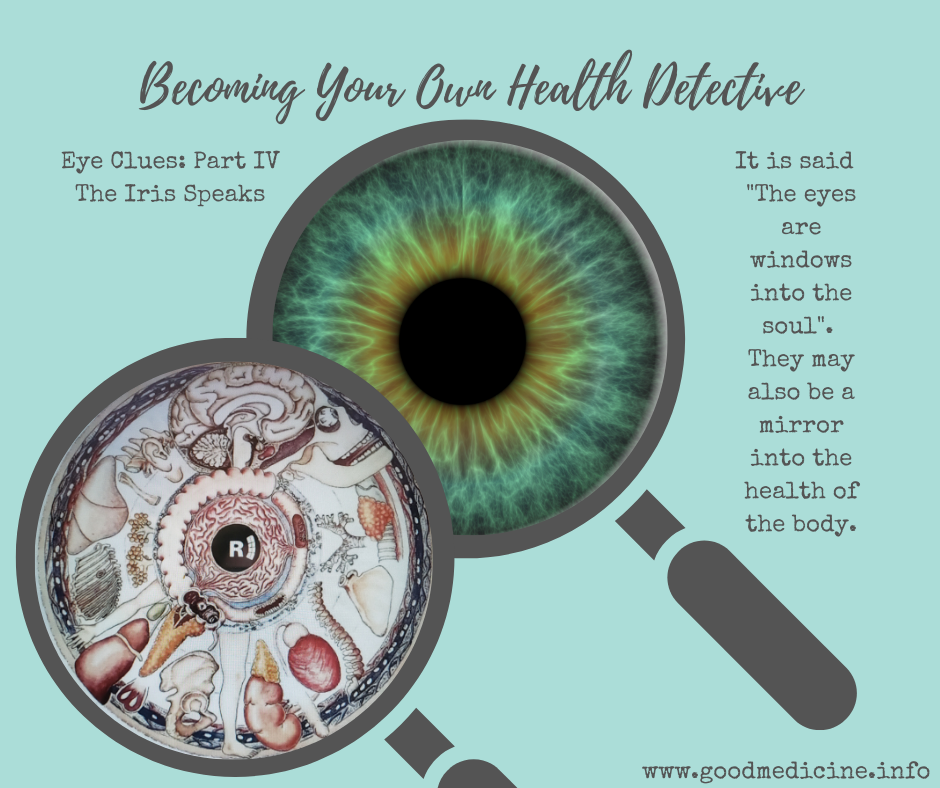
Eye Clues Part IV: What do your irises say about your overall health?
Perhaps you’ve heard the phrase, “The more you learn, the more you realize you don’t know.” It’s one of the reasons I identify as a lifetime student. I pray that I am able to learn something new every day. This next foray into clue finding required diving a little deeper into a topic I’m fascinated by, but certainly no expert!
The iris is the part of the eye that carries color. Iridology is a form of “clue finding” in which patterns, colors, and other characteristics of the fibers of the iris are examined. Just as with feet,✋ hands, 👂ears, 😛tongue, 👩face, and skin… the iris is loaded with body health clues🔎! The eye itself is a visible extension of the brain with hundreds of thousands of nerve endings, a vast microvascular network, muscles, and other tissue types. Interestingly, the iris is connected to every organ and tissue of the body by way of its role in the central nervous system. The iris is also controlled by sympathetic (“fight or flight” response) and parasympathetic (basic body “housekeeping” and autopilot “at rest” activities), so if you imagine that trauma, drama, or a toxin load might affect affect the iris, you’d be right! Nerve fibers in the iris respond to changes in body tissue. As the changes in the body tissue occur, those changes also physically manifest in the portion of the iris which “identifies” with that portion of the body tissue. The result is this: the color part of our peepers drop clues relating to past, present, and possibly future health. Even having a basic understanding of clues🔎 within the iris may help you identify how best to support and care for your body by suggesting where inflammation may be, and at what stage it may be manifesting.
*There are 90 known body specific areas that are mapped on each iris. Each eye is different. These areas are mapped out much like spokes on a wagon wheel, with the pupil being at the center axis. There are also 7 concentric zones of the iris beginning at the pupil. The stomach and intestines are closest to the pupil, followed by:
Zone 3: representing heart, bronchi, pancreas, adrenal, pituitary, pineal, gallbladder
Zone 4: representing prostate or uterus , skeleton
Zone 5: representing brain, lung, liver, spleen, kidneys, thyroid
Zone 6: representing muscles, motor nerves, lymphatic, circulatory
Zone 7: representing skin, sensory nerves
Today, we’re only going to talk about the overall appearance of the iris. Compare the “texture” of the iris to a piece of cloth. Does it appear tightly woven like silk or more loosely woven together like burlap or cheesecloth? There is a correlation between the “tightness” of the fibers of the iris with the body’s ability to hold and utilize nutrients, dispose of metabolic waste and toxins, and have general robust cellular activity. More “loosely woven” iris fibers trend towards a correlation with difficulty maintaining nutrient levels and efficiently disposing of metabolic waste and toxins.
This may be a valuable clue to note in your health🔎 detective journal. Remember, clues are not diagnoses….. they are a gift from our Creator so that we may notice changes and work towards achieving better health…. a constant & evolving process. Sometimes it may feel like two steps forward and three steps back. #metoo. We all have our own health journey with seasons of success and seasons of lack, with lots of moving parts that we can choose to control or leave to chance. Scientists👩‍🔬 and doctors👨‍🔬 who have studied the iris closely have found that irises which suggest a weaker constitution can belong to healthy people who take care of themselves well. Likewise, irises suggesting a strong constitution of the body can also be made weak over time through toxin exposure and lack of care. Epigenetics (the environmental component of gene expression that we CAN control) plays a tremendous role in our health!
If you are so inclined, grab a magnifying glass, light and mirror (partnering up may be easier) and happy clue hunting! . Make note of what you see compared to how you feel overall, and how you might be feeling if you weren’t taking care of yourself in “all the ways”.
I know I would feel much different if I weren’t faithful with my eating and exercise habits, self care routine, and of course….my daily supplement routine: Sulfurzyme, BLM, Thyromin, Femigen/Progessence Plus, OmegaGize, NingXia Red, Multigreens, and others on board!
We’ll dive just a little deeper next week!
xoxo~ liz

#sharingiscaring

#supportyourlocalpeepers
#goodmedicine
#goodmedicineisproactiveinsteadofreactive
#ThanksYL
#youareworthit

  • « Go to Previous Page
  • Page 1
  • Page 2
  • Page 3
  • Page 4
  • Page 5
  • Page 6
  • Interim pages omitted …
  • Page 11
  • Go to Next Page »

Book Your Health Coaching CallBook Now

Elizabeth James

469.425.9091

ebj0203@gmail.com