Adrenal Fatigue DIY tests you can do at home
“One small clue can change the way you think about your surroundings quite dramatically.” ~The Lost Art of Reading Nature’s Signs
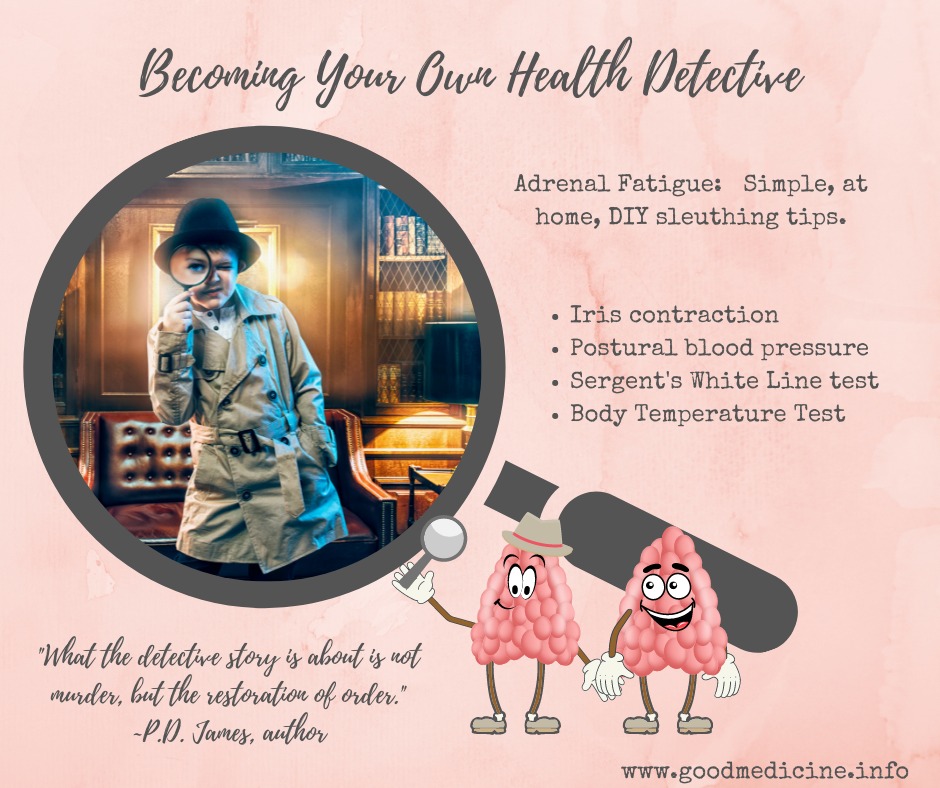
When last we met, I unloaded a truckload full of clues pertaining to health history, stress history, and the physical health clues to be found within the story and advancing progress of adrenal fatigue. Being aware of your very personal surroundings (your body and history), and caring for your body based upon that history has everything to do with health outcomes. Using the clues you piece together, along with formulating a plan to “correct course” will have a dramatic impact over time. There are four DIY tests for monitoring your adrenal health. Independently, each test is a puzzle piece.
4 simple and free tests (combined with the clues mentioned previously) will paint a decent picture of your adrenal health.
1. Check eyes for iris contraction: This particular DIY is a study of the  pupil’s muscular strength in response to light stimulation, and is an excellent indicator of adrenal gland struggles. Our eyes respond to stress too, by dilating pupils (Hence the term, “deer in the headlights.”).They do this as a means of increasing visual observations of the perceived threat. Remember, “the lion” that may be chasing you could be a looming deadline, a toxic relationship, a chronic health issue, etc. Compared to a real lion chasing you, these common examples may seem benign, but the body and mind cannot discern the difference between a ferocious mammal or a pile of unpaid bills. As stress increases and adrenaline is released, peripheral vision shrinks, which reduces the field of vision to a laser focus on the immediate threat at hand. When the body is in this state, the eyes are focused on the immediate threat, not the other environmental details, and a sort of tunnel vision develops….. Under a single looming threat (aka, “the lion”), the physical effects should wear off as soon as the threat has moved on. If that threat continues to stalk you, small doses of adrenaline continue to release. When the muscles within the iris are exercised in this manner beyond capacity, they grow weary, and want to rest. If you have low adrenal function, the pupil will not hold the contraction(get smaller) easily.
 pupil’s muscular strength in response to light stimulation, and is an excellent indicator of adrenal gland struggles. Our eyes respond to stress too, by dilating pupils (Hence the term, “deer in the headlights.”).They do this as a means of increasing visual observations of the perceived threat. Remember, “the lion” that may be chasing you could be a looming deadline, a toxic relationship, a chronic health issue, etc. Compared to a real lion chasing you, these common examples may seem benign, but the body and mind cannot discern the difference between a ferocious mammal or a pile of unpaid bills. As stress increases and adrenaline is released, peripheral vision shrinks, which reduces the field of vision to a laser focus on the immediate threat at hand. When the body is in this state, the eyes are focused on the immediate threat, not the other environmental details, and a sort of tunnel vision develops….. Under a single looming threat (aka, “the lion”
 ), the physical effects should wear off as soon as the threat has moved on. If that threat continues to stalk you, small doses of adrenaline continue to release. When the muscles within the iris are exercised in this manner beyond capacity, they grow weary, and want to rest. If you have low adrenal function, the pupil will not hold the contraction(get smaller) easily.
The iris contraction test was originally discovered by Dr. C.F. Arroyo in 1924 as a means to help identify adrenal insufficiency. Here’s what you’ll do:
 Here’s what you’ll do:
Sit in a dark room with a mirror, a flashlight, and a clock that measures in seconds. Sometimes this test is more easily done with a companion. Shine the flashlight across an eye (from the side of the face), and watch what happens to the pupil. Under healthy circumstances, the pupil should contract (get smaller) immediately. In adrenal insufficiency, the pupil will not be able to hold the contraction and will dilate (get larger) again despite the light shining across (not into!) it. How long is your eye able to maintain the smaller contracted pupil size in this test?
-
20+ seconds : healthy!
-
11-19 seconds: early clue of adrenal struggles
-
5-10 seconds: adrenal insufficiency
-
0-4 seconds: adrenal exhaustion
Note that this test is also a good one to use monthly to measure success during adrenal recovery, and that certain neurological and ophthalmological dysfunctions, medications (ex: stimulants, opioids, some OTC medicated nasal sprays, nicotine, certain eye drops and some chemotherapy agents) , and age parameters (the very young and elderly) may affect the reliability of this test.
2. The DIY Postural Blood Pressure Test: For this test, you’ll need an “at home” blood pressure cuff.
-
Lay down for about 10 minutes, and then take the blood pressure while in that position.
-
Then, take blood pressure immediately after standing up (from the original laying down position).
-
Blood pressure should rise 10-20 mm/Hg when coming from a laying to standing position. If it instead drops by 10 mm/Hg or more, and there is not other cause (ex: dehydration, electrolyte imbalance, an injury, or certain medications including blood pressure medications, antidepressants, benzodiazepines, opioids, anti-psychotics),adrenal insufficiency is a strong possibility
-
Increase by 6-10 mm/Hg : adrenal status healthy
-
No change: adrenal status is fair
-
Drops 1-10 mm/Hg: adrenal status is poor
-
Drops by more than 10 mm/Hg: adrenals are exhausted. Note that an overall low blood pressure does not indicate adrenal problems, and also that an overall high blood pressure does not mean an absence of adrenal issues.
3. The DIY Sergent’s White Line Test: French physician Dr. Emile Sergent first described this test in 1917. French physician Dr. Emile Sergent first described this test in 1917. You’ll need your belly and a ballpoint pen.
French physician Dr. Emile Sergent first described this test in 1917. You’ll need your belly and a ballpoint pen.-
Stroke your abdomen with the capped end of a ballpoint pen (or something equivalent). Make the strokes one over the other on the same 6 inch line.
-
Note the reaction of the skin. What color does the skin turn when you quit stroking that area?
-
In a normal reaction, the mark should be white, but then redden within seconds. If you have diminished arterial tension (a factor in compromised adrenal glands), that color line will stay white for a minute or two and may actually widen.
4. DIY Body Temperature Test : Dr Bruce Rind MD is another beacon of light within the Western Medicine world. The body temperature test I am describing is one of his contributions to identifying adrenal distress. Recall that endocrine disorders often have a masquerade party amongst themselves (and other disorders!), making it hard to differentiate who the real party pooper is in your personal health situation. Dr. Rind recommends the following test as a means of identifying hypothyroidism, adrenal dysfunction (or a combination of the two).
 test I am describing is one of his contributions to identifying adrenal distress. Recall that endocrine disorders often have a masquerade party amongst themselves (and other disorders!), making it hard to differentiate who the real party pooper is in your personal health situation. Dr. Rind recommends the following test as a means of identifying hypothyroidism, adrenal dysfunction (or a combination of the two).
-
Take your temperature by placing an old fashioned thermometer under your arm at a 45 degree angle.
-
After 10 minutes, record the temperature.
-
Do this three times a day at 3 hrs after waking, and then 3 hours later, and again 3 hours after that (if you’ve eaten or exercised right beforehand, wait 20 minutes to take your temperature).
-
Average these three daily readings and record the result.
-
Do this for 5 days (making sure that during that time you are healthy and not ovulating)
-
If the difference between your daily average temperature reading is no more than 0.2 degrees: no indication of adrenal or thyroid dysfunction.
-
If fluctuating, but the overall average is 98.6, adrenal support is recommended.
-
If fluctuating but overall low, it may indicate both an adrenal and thyroid issue.
-
If there is very little to no fluctuation, but temperature remains low, focus on the thyroid.
So interesting, right? I love how the body speaks to us in very intentional ways. If your body is giving you clues that your adrenal glands and/or thyroid is in need of serious TLC, it may be a good time to call in a trusted health professional to help you navigate this part of your journey. There are also some advanced labs that can be run to further put the pieces of the puzzle together. Sadly, the majority of standardized health insurance companies do not cover these VIP tests. That said, nothing is more important than your health, and ignoring health clues and foregoing tests because they are a ”too expensive” out of pocket expense will become an exercise of frustration and detriment. I really recommend having a “rainy health day” fund established simply to pay for supplements, oils, alternative health care options, and lab work that traditional insurance won’t cover. You’ll be glad you did!
 to us in very intentional ways. If your body is giving you clues
 that your adrenal glands and/or thyroid is in need of serious TLC, it may be a good time to call in a trusted health professional to help you navigate this part of your journey. There are also some advanced labs that can be run to further put the pieces of the puzzle together. Sadly, the majority of standardized health insurance companies do not cover these VIP tests. That said, nothing is more important than your health, and ignoring health clues and foregoing tests because they are a ”too expensive” out of pocket expense will become an exercise of frustration and detriment. I really recommend having a “rainy health day”
  fund established simply to pay for supplements, oils, alternative health care options, and lab work that traditional insurance won’t cover. You’ll be glad you did!
xoxo~ liz
Becoming Your Own Health Detective Volume I ( https://goodmedicine.info/my-book/ )
PS: Did you hear Dr. Jim Bob Haggerton‘s call last night on adrenal fatigue? It was fabulous and loaded with information! As soon as it’s available, I’ll drop a link to it in the comments section here.