• Skip to primary navigation
  • Skip to main content
Book Your Health Coaching Call
Good Medicine

Good Medicine

Holistic Health Coaching

  • Home
  • Liz James
    • About Liz
    • Coaching
    • Book a 20 Minute Complimentary Coaching Call
  • Favorite Resources
    • BlessedByHisBlood
    • Young Living
    • Fast Like A Girl Certified Coach
    • Order supplements through my Fullscript store
    • Green Pasture (Coupon: Health10)
    • RogersHood Apothecary (Coupon: BEABLESSING for 10% off)
    • DolphinMPS
    • Company
    • Abundance
  • My Books
    • Becoming Your Own Health Detective Volume 1
    • Becoming Your Own Health Detective Volume 2
  • Blog
  • Cart

Toxins

Adverse Events – COVID Jab

Liz James · January 22, 2022 ·

“….Collateral damage”. In war, there is a legal concept that exists where there is some “acceptable level” of damage to innocent bystanders. This is decided upon by those who are deciding the rules of engagement.
But what if….. the collateral damage (casualty list) is greater than the casualty list of the soldiers fighting? In my opinion, I’d start to question the intelligence and allegiance of who is directing the lobbing of the bombs (or whatever other method of destruction is being used).
To Date: 1,053,828 (over 1 million ) C O V D Jab adverse events reported in the USA alone. https://openvaers.com/ . This includes 22,193 jab reported deaths. (and we know that these numbers are MUCH MUCH higher according to a Harvard Study).

Recent news is revealing more and more each day about the real C O V D death numbers and the actual numbers of people dying FROM Covid are quite different from those dying WITH Covid. Comorbidities (2.9 on average) and the sheer inaccuracy of PCR testing ( https://childrenshealthdefense.org/…/pcr-testing…/ ) ….. but I digress.

When the numbers affecting those who have been “collaterally damaged” surpasses those who were killed fighting a war, there’s a problem. We’ve long arrived at that problem.

Risk versus benefit is something medical professionals should be well trained in. It’s something we should all be trained in just in day to day living. We are the CEO of ourselves. As the CEO, the health of each of our “companies” is dependent upon risk versus benefit analysis.

Run your body the way you’d run a business. (Accurate) numbers don’t lie.
xoxo~ liz

Button below has the link to the VAERS website.

Vaers
us government to end daily covid death reporting

Children Need Cooties

Liz James · January 16, 2022 ·

Isn’t that snapshot of the microbiome on that child’s hand beautiful? Pretty is as pretty does. Our body NEEDS cooties. Without them, we’d be in a sorry state. Take care of whatcha got, and work to create diversity among the community within you. You won’t regret it! 😉
xoxo~ liz

The microbiome is truly beautiful! 🍄

*This is the hand of an 8-year-old boy who placed his hand on a petri dish after coming inside from playing. Now I am sure at first glance you thought to yourself how disgusting this is and how this MUST be a bad thing, however, it is actually the contrary

  • First I want to point out that we are made up of more foreign matter than we are our own cellular DNA. Let me explain, there are more microbes in and on your body that quantitatively make up more cells than the ones that are YOU
  • The microbiota is said to be about 1.3 for every 1 cell that is our own. These microbes are responsible for keeping us healthy, digesting our food, creating nutrients, assimilating our vitamins/minerals, the processing of our information/neurotransmitters, our immunity and nearly every process and mechanism in the entire body. They exist in your mouth, on your skin and most importantly in your gut. (Terrain)
  • With the continuous rise of industrialized farming, environmental toxins, and even the overuse of hand sanitizers, we are not only depleting the microbes in our soil but the ones on our bodies, too. This is like taking down our force field and allowing the pathogenic bacteria, viruses, mold, and other pathogens to infiltrate. .
  • This post is to continue to create awareness that bacteria/fungus/viruses are not truly “bad,” and we must support a healthy microbiome inside/out. THEY ARE OUR FRIENDS and we must respect life even down to its smallest counterparts
  • The avg. human should have about 3.5lbs of gut flora in the intestines, however, on the standard American diet of overly processed/refined foods and the overconsumption of pesticides/insecticides, as well as the other near 80K man-made chemicals we interact with daily, we would be lucky to have a couple ounces
  • Do your best to avoid high 💯 alcohol-based hand sanitizers as they kill our first line of defense, the same for your mouth, avoid using alcohol-based mouthwashes and synthetic chemicals in/on your bodies; you want to support our little friends, not kill them off. 👾
  • PARENTS this is especially important for your developing children and THEIR microbiome! @tasturm1
    ⌨️ @dr.josepharena
    Shared from Beautiful Beginnings

Parents Must Know!

Liz James · January 6, 2022 ·

“For wisdom will come into your heart, and knowledge will be pleasant to your soul; discretion will watch over you, understanding will guard you. ” ~ Proverbs 2:10-11

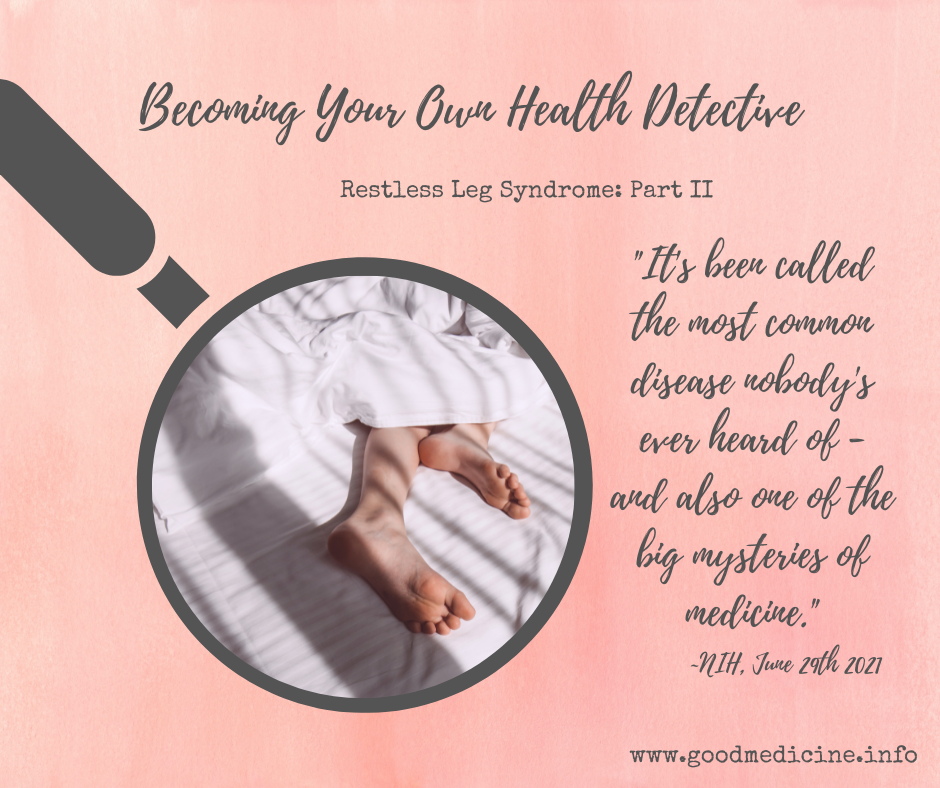
Restless Leg Syndrome – part 2

Liz James · December 28, 2021 ·

​Restless Leg Syndrome: Respite Part II
One of the honed skills of a most excellent detective revolves around the process of eliminating suspects. This is key in nabbing the right culprit. How many news stories have you read about the wrong person languishing in jail for a crime they didn’t commit? The same is true when parsing health clues…. We’ve got to find the true offender.
The reality is that there may be a single culprit, or a gang of culprits….. AND, there might be some shady characters who look suspicious, but are not the real troublemakers. As the lead health detective, you may choose to haul them in for questioning (closer evaluation), only to find out they are truly innocent. Don’t get discouraged…. readjust your Sherlock Holmes cap and move on to question the next suspect! 
As you’ve learned, all restless leg syndrome cases are unique. Unfortunately, nearly all cases are treated the same way by introducing pharmaceuticals to mediate discomfort. The most common medications used are anti-seizure medications (ex: gabapentin), drugs to treat Parkinson’s (ex: levodopa/carbidopa), opioids (ex: tramadol), or benzodiazepines (ex: clonazepam). I can personally guarantee that while each of these may soothe the legs, if used long term, will lead to misery and/or dysfunction in another part of the body.
If you’d like to build some gentle DIY soothing support for restless legs while you work on finding the root cause, try these recipes and find the one that serves you best. You’ll not want to stop here tho, because the culprit is still on the loose.
(Each recipe makes a 10ml roller bottle)
🌿Recipe #1🌿
20 drops Marjoram
20 drops Roman Chamomile
10 drops Lavender
10 drops Frankincense
Fill remaining space in roller bottle with carrier oil.
******
🌿Recipe #2🌿
15 drops Lavender
10 drops Roman Chamomile 
10 drops Vetiver
5 drops Lemongrass
5 drops Marjoram
5 drops Blue Yarrow
5 drops Peppermint
5 drops Clove
3 drops Ginger
3 drops black pepper
Fill remaining space in roller bottle with carrier oil.
******
🌿Recipe #3🌿
AromaSiez (snap a roller fitment on that puppy and use as is!)
*****
🌿Recipe #4🌿
10 drops Peace & Calming
10 drops Panaway
10 drops Stress Away
10 drops Lavender
Fill remaining space in roller bottle with carrier oil
*****
Other ways to naturally alleviate the discomfort of restless legs include:
*Reducing caffeine intake (especially after lunch)
*Stop smoking
*Weight loss (Recall that elevated BMI contributes to restless legs)
*Increased exercise
*Cryotherapy
*Warm or cold compresses
*Weighted blankets
*Avoiding certain foods including processed foods, fatty fried foods, sodas, sugar, excessive alcohol, and caffeine. 
*Adding specific food “tools” to your diet (ex: cashews, almonds, peanuts or brown rice) that are rich in magnesium. If you add magnesium to your diet thru supplementation, you’ll want to look for forms such as glycinate or malate for maximum bioavailability.
*Balance your micronutrient load with Young Living’s Mineral Essence and NingXia Red. You’ll be so glad you added both of these to your routine! 
*Young Living CBD muscle rub. CBD has a relaxing effect on the muscles and a calming effect on nerves.
*Work on ways to improve your natural dopamine levels.
*Quinine water (true tonic water)
If you’ve done your prep work, you may now have a line up of suspects causing your restless legs. I am an enormous advocate of proper and extensive lab work, as concrete answers eliminate the guesswork. It will save both time and frustration.
-Iron deficiency may be easily identified and treated once you have concrete lab work answers on both iron and ferritin levels. It’s not generally a good idea to supplement iron until you know. Too much iron in the body can be quite damaging over time.
-If you suspect a hormone imbalance (including thyroid) may be a contributing factor, lab work can confirm your suspicions.. A hormone imbalance will also yield many other possible clues. Find your clue cluster, and you’ll likely find the culprit, and then you can get to work on the solution! 
-Nutritional deficiencies can be so very subtle, and don’t always have a strong set of clues. Magnesium is a simple and safe supplement to try if lab work simply isn’t possible. Ample magnesium in the diet is also helpful for reducing chronic constipation episodes, reducing symptoms of depression, improving PMS symptoms, preventing migraines, and more!
-Kidney disease can be a hard one, as both the disease itself and many medications used in chronic kidney disease patients are potential culprits. 
-Arguably, drug 💊induced restless legs is among the biggest offenders. Not surprisingly, countries that do not rely on pharmaceuticals as their predominant mode of care have the lowest incidence of restless leg syndrome within their population. Additionally, these countries also tend to live within a diet structure that has minimal processed foods and sugars available to them. 
Take a close look at the medications that can cause restless legs (last week’s post). The biggest known offenders are 💊acid reducers (ex: omeprazole, pantoprazole, esomeprazole) 💊  escitalopram, 💊fluoxetine, 💊levodopa/carbidopa, 💊, levothyroxine, 💊mirtazapine, 💊olanzapine, and💊 tramadol.  Many of these medications could be avoided with lifestyle choices and changes that address balancing mind, body, and spirit.
Approximately 10% of the population is on medication for heartburn and GERD related symptoms. According to a recent study:
 “… consuming these powerful acid-blocking agents is strongly linked to a significantly higher incidence of restless legs syndrome, compared to those who did not consume these medications.” 
Gah! Please go back and re-read all you’ve learned about the clues within the digestive system. Pairing up clues is the name of the game!
Finally, if you have children, remember that restless legs is not an “adults only” dysfunction. Up to 6% of kiddos have restless legs which often are undiagnosed or misdiagnosed. Kids are not always able to verbalize what they are experiencing, which can add to the challenge. Sleep, mood, cognition, and quality of life are significantly affected in the pediatric population. Not surprisingly, ADHD, depressive symptoms and anxiousness are often included in the clue cluster.
xoxo~ liz

##sharingiscaring
#goodmedicine
#Godgaveusallweneedinthegarden
#BecomingYourOwnHealthDetective
#ThanksYL

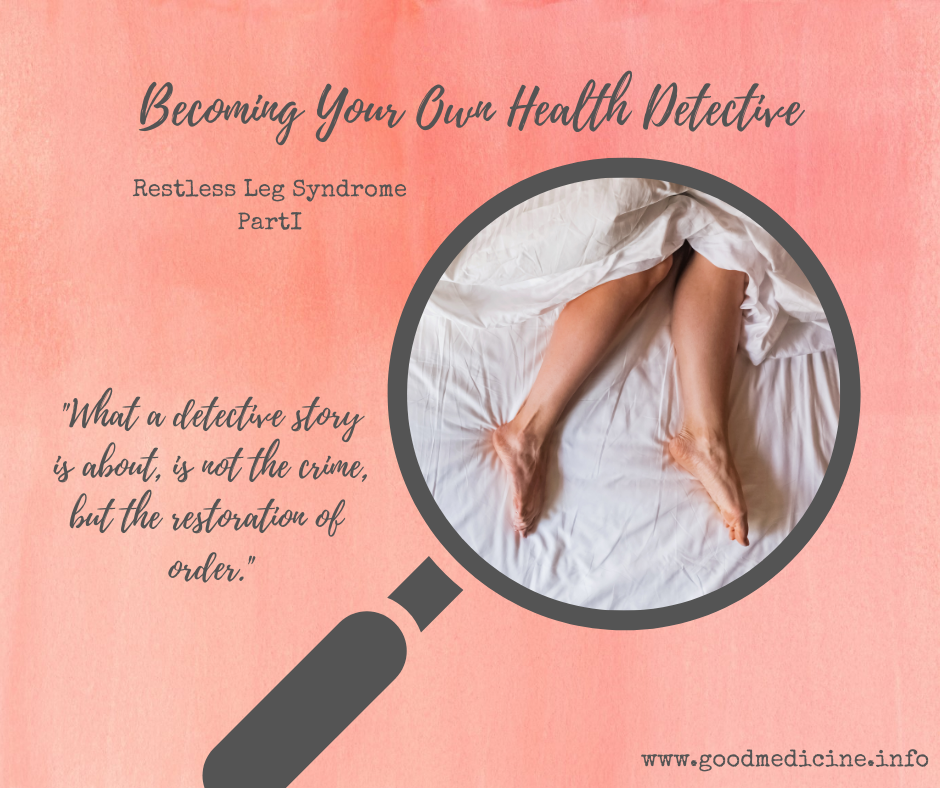
Clues from Restless Leg Syndrome – part 1

Liz James · December 21, 2021 ·

The Trail of Clues in Restless Leg Syndrome: Part I
OK friends, let’s take a quick quiz straight from the pages of the National Institute of Health. These 4 questions are a simple “yes” or “no” answer, and will help identify if this next set of clues resonates with your current situation. 
✅Do you have a strong and often overwhelming need or urge to move your legs? (Often the urge may be accompanied by abnormal, unpleasant or uncomfortable sensations.)
✅Does the urge to move your legs start (or get worse) during rest and inactivity?
✅Does the urge to move your legs worsen in the evenings/at night?
✅Is the urge to move your legs partially or totally relieved by movement (at least temporarily)?
If you have answered yes to these questions, this post series may shed light on both why your legs may be restless and (next week) natural ways to help relieve the situation.  Bear in mind that beyond the questions above, there are several mimickers of restless leg syndrome, so the process of elimination may come in handy!   Poor circulation in the legs, fibromyalgia, neuropathy, and ADD/ADHD are a few disorders known for restless leg mimicry.
Restless leg syndrome (RLS)  is a very common condition affecting about 10% of adults in the USA and even some children. There are several medications commonly used to treat RLS. According to many pharmacy clients I’ve worked with over the years, the medications are often minimally effective, not without unpleasant side effects (GI distress, constipation and/or diarrhea), and do not address root causes.
RLS is not generally a precursor of things to come thankfully….but it is highly annoying and life disruptive nonetheless, especially as it often leads to chronic insomnia.
As any good detective would do, you’ll want to discover the motive (root cause) of your  RLS. Motives vary in each case, right?
*Occasionally, restless legs may be blamed on genetics, but that is the exception rather than the rule. Overwhelmingly, restless leg syndrome is given the dubious distinction of having an idiopathic origin. My personal feeling is that “idiopathic” is an overused medical term used when not enough time has been spent looking at clues to find the root cause! Understandably so….. insurance companies do not usually allow doctors the time or tools (comprehensive lab work) to actually find the source of the problem.
There are MANY factors leading to or exacerbating restless leg syndrome:
*Approximately 15% of RLS cases have an underlying iron deficiency. Iron deficiency may be easily checked with lab work. Checking iron alone is insufficient. Ferritin levels also need to be evaluated.
*Other nutritional deficiencies contributing to RLS include magnesium, calcium, potassium and/or zinc. Again, blood work is key. (If you get magnesium tested, make sure it is magnesium bound to red blood cells “mRBC” for a more accurate reading)
*Hormone imbalance is another common cause. Approximately 20% of pregnant women develop RLS, usually in the third trimester. This symptom tends to dissipate about 4 weeks after delivery of the baby. Women are more likely to have hormonal imbalances than men overall, and women are also more likely to develop RLS than men in life. Hyperthyroidism, another type of hormone imbalance, is an additional contributor.
*Dopamine is a neurotransmitter that plays many roles in the body, most notably in motivation and positive reinforcement of behavior. It also plays a critical role in the control of movement. So, as you might imagine, a dopamine imbalance may also play a key role in RLS. (We’ll cover dopamine deficiency in the near future.)
There also appears to be a relationship between ADD/ ADHD and restless leg syndrome. Additionally, pediatric restless leg disorder is sometimes misdiagnosed as growing pains or ADD.
*Symptoms of restless leg syndrome are common in people who have chronic kidney disease.  When the kidneys are not functioning as they should, anemia, iron deficiency, and high calcium levels in the blood commonly occur. As you’ve just learned, all of those conditions exacerbate RLS.
*Hypertension, diabetes, and increased BMI (body mass index) also contribute to the incidence of restless leg syndrome. (The medications used to manage these conditions are also worthy suspects!) Uncontrolled high blood sugar often leads to peripheral nerve damage; another contributor to restless legs.
*Medication induced restless legs may be among the most common (idiopathic?) causes for developing this disorder. Every medication acts in multiple ways throughout the body. Immediate side effects of medication are fairly easy to spot, but often side effects such as restless legs creep in slowly, making it hard to pinpoint the culprit. Medications known to cause restless legs over time include:
💊Certain antihistamines
💊Psychotropics (ex: haloperidol, aripiprazole, risperidone, quetiapine, mood stabilizers)
💊Antidepressants (SSRI’s,SNRI’s, and tricyclics, ex: fluoxetine, sertraline, venlafaxine, paroxetine, imipramine, amitriptyline)
💊Some nausea medications (metoclopramide and prochlorperazine)
💊Acid reducers
💊Beta Blockers
💊Calcium channel blockers
💊Some sleep medications
I’ve talked to many pharmacy clients over the years who struggle with restless legs, and while it is a relatively benign condition, it is definitely life altering…anything that negatively affects quality sleep is! Westernized health culture is often very quick to prescribe or suggest over the counter medication to quickly solve a problem, overlooking the unintended possible consequences. Often, there is a gentler solution, but it does require ownership and a willingness to take personal responsibility for one’s own health management.  There will always be a time and a place for western medicine, but it behooves us all to leave that as a last resort whenever possible.
I hope this helped someone identify their restless leg trigger(s). Next week I’ll talk about healthy options for living with RLS.
xoxo~ liz
#sharingiscaring
#goodmedicine

  • « Go to Previous Page
  • Page 1
  • Interim pages omitted …
  • Page 7
  • Page 8
  • Page 9
  • Page 10
  • Page 11
  • Interim pages omitted …
  • Page 40
  • Go to Next Page »

Book Your Health Coaching CallBook Now

Elizabeth James

469.425.9091

ebj0203@gmail.com