• Skip to primary navigation
  • Skip to main content
Book Your Health Coaching Call
Good Medicine

Good Medicine

Holistic Health Coaching

  • Home
  • Liz James
    • About Liz
    • Coaching
    • Book a 20 Minute Complimentary Coaching Call
  • Favorite Resources
    • BlessedByHisBlood
    • Young Living
    • Fast Like A Girl Certified Coach
    • Order supplements through my Fullscript store
    • Green Pasture (Coupon: Health10)
    • RogersHood Apothecary (Coupon: BEABLESSING for 10% off)
    • DolphinMPS
  • My Books
    • Becoming Your Own Health Detective Volume 1
    • Becoming Your Own Health Detective Volume 2
  • Blog
  • Cart

Health Policy & Medical Ethics

Dopamine Deficiency -part 2

Liz James · January 24, 2022 ·

Dopamine Deficiency Part II: The Medication Connection

When the topic of substance abuse is broached, the neurotransmitter dopamine is often brought into the conversation. Recalling our earlier discussion, dopamine contributes to feelings of pleasure and satisfaction and directly influences the way our brain achieves happiness by “guiding” our behavior to get to that feeling. Heroin, cocaine, and MDMA (ecstasy) are three of the bigger illicit guns that initially trigger a surge of dopamine in the body. Sugar also induces a massive (but short lived) dopamine surge. The body is filled with protective mechanisms (thankfully!), and if dopamine surges continue, a mechanism will kick in that reduces the number of dopamine receptors available for triggering. Consequently, it becomes harder and harder to achieve the same feelings of pleasure. As you may have already guessed, common opioid prescription medications do this too especially when used chronically. Some offenders would include:
💊Hydrocodone
💊Codeine
💊Tramadol
When you review the introduction to dopamine deficiency (see Part I), you’ll notice that neurodegenerative conditions, chronic back pain, aches and pains, and persistent constipation are symptoms of deficiency. Those are also four very common complaints in people who use these pain medications chronically. Certainly, other factors are involved as well (do some digging!), but dopamine deficiency plays a significant role.
Dopamine sabotage by way of medication💊 is also an unfortunate common side effect of drugs that block dopamine binding to receptor sites. When a medication does this, dopamine cannot “do its work” in the body.
💊Haloperidol is used to treat schizophrenia, Tourettes, and severe behavioral problems in children and adults.
💊Risperidone is used to treat schizophrenia, disinterest in life, strong or “inappropriate” emotions, or disturbed thinking.
💊Metoclopramide is used to treat GERD, nausea/ vomiting, and slowed gut motility.
💊Olanzapine, Aripiprazole, Quetiapine are used to treat schizophrenia, bipolar disorder, and depression.
💊Buspirone is used to treat anxiety.
🧐If you were to pick up and read a package insert on each of these medications, you would find side effects listed giving evidence of dopamine deficiency (refer to Part I for symptoms).
What I write next might be the most technical and one of the most important concepts to understand in this entire book, so stay with me…. even if the slogging feels uphill! According to the National Institute of Mental Health (NIMH), an estimated 1 in 5 adults have a mood disorder in the USA. Sadly, when prowling around the NIMH website, I found very little in the way of suggesting lab work to rule out a hormonal, thyroid, or nutrient imbalance, or selfcare suggestions (clean diet, well developed exercise routines, tips on improved sleep hygiene, or connecting with a high frequency community, and most importantly, having a personal relationship with God). The website is quick to advocate for mental health medicating. Go figure.
💊Selective Serotonin Reuptake Inhibitors (SSRI’s) are a class of drugs used to treat depression, anxiety, and other mood disorders. Common SSRI’s include 💊Citalopram, 💊, Fluoxetine, 💊Paroxetine, and 💊Sertraline. By definition, this class of drugs is supposed to be “selective” in their mechanism of action, and while they are marketed as products that raise serotonin in the brain, they simultaneously lower dopamine levels significantly. Additionally, there is very strong evidence that, depending on the individual and the SSRI used, there may be a significant effect on the HPA (hypothalamus, pituitary, adrenal) axis in the brain, where cortisol, hormones (including serotonin and dopamine) are regulated and long term memories are stored. The hypothalamus and the pituitary play a significant role in regulating the thyroid. You may imagine how important all of this is in balanced overall body and brain function.
I offer this information to you as clues, not as medical direction or individualized medical advice. Risk versus benefit should always be first and foremost whenever utilizing a medication, especially one that modulates “motherboard” (brain) activity. I read one doctor’s thoughts recently who described antidepressant use as a “sledgehammer to repair a fine watch.” Does the tool fit the need? That is only for you and your healthcare provider to decide.
Last week, I listened to a podcast that dovetailed into this topic. It is called “Unscientific Diagnoses Medicalize Normal Human Experience”. I’ve posted a link to this 30 minute podcast below. You won’t regret listening to it. We must get back to living in tightly knit communities where we love and care for one another well while also learning that experiencing emotions in a healthy manner is part of vibrant living. I’m so very very thankful for Young Living, because we exemplify that community, and there is plenty of room at the table for everyone who wants to #knowbetteranddobetter for themselves and their families.

We live in a broken world that is bandaged by a broken medical system. I encourage you to use your finely tuned tools for finely tuned processes in the body. Whenever possible, leave the sledgehammer in the shed.
Next week, I’ll discuss readily available inexpensive tools to help support optimal dopamine levels.
Until then~
xoxo, Liz

#caringissharing
#knowbetterdobetter
#dopamineisdope
#balanceddopamineisgoodmedicine
#goodmedicine
#BecomingYourOwnHealthDetective
#ThanksYL
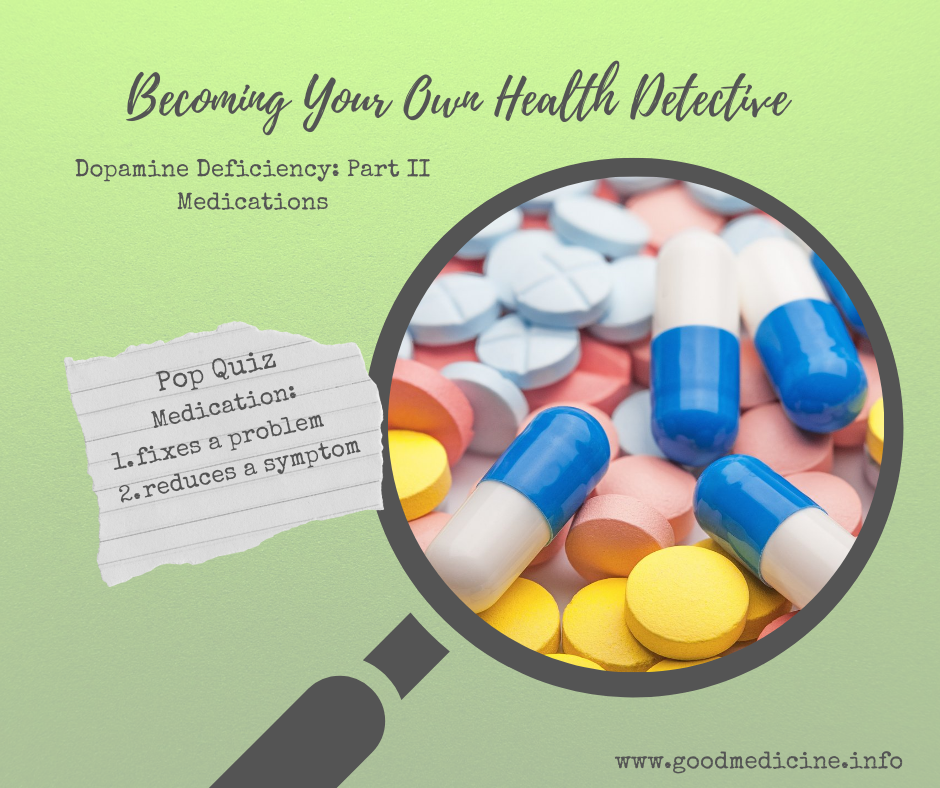
(If you answered #2, you’d be correct!)
unscientific Diagnoses Medicalize Normal Human Experiences

Unscientific Diagnoses Medicalize Normal Human Experience

Liz James · January 17, 2022 ·

Last week, as I was getting ready at my hotel for a leadership conference, I listened to this mic🎤 💥drop podcast: “Unscientific Diagnoses Medicalize Normal Human Experiences”. I sat down late that night to share it with you all…. and wouldn’t you know it, the black hole of social media oblivion swallowed it when I hit “post”. So, here I am… back home ….. trying again! Yes, this information is THAT important… that I’m willing to write about it twice.

We are taught how to think. All of us. Healthcare professionals and laypersons alike. However, what we are taught isn’t necessarily true. Nonetheless, we believe and act upon those beliefs. This podcast shatters some of those beliefs that surround mental illness.

Key points of the podcast:

  • There is no research evidence for a chemical imbalance that leads to mental health problems. Example: Low serotonin levels are blamed for depression. This is an overly simplistic myth perpetuated by Big Pharma. The reality is that serotonin levels cannot be easily measured in the brain (if at all).
  • Where do ideas about the cause of mental distress come from? We (as a cumulative society) are led to believe they come from a chemical imbalance as perpetuated by prescribing physicians, pharmaceutical ads (a pill will fix ya), pop culture (normalization of a pill for everything), and interaction with family and friends who endorse the “pharmaceutical fix” model. (note: in cultures where Big Pharma 💊 doesn’t have a big footprint, mental health disorders are quite low.)
  • Side effects of antidepressants include chronic depression (that’s a fact).
    Normal human experience includes suffering in life. Suffering may mean something different to each of us. Perhaps it is grief, social shyness, disappointment, fear, angst, or __ (fill in your blank). Experiencing suffering does not mean the brain is broken….. it just means you (we) all are living a human experience and processing emotions as we go. Don’t get me wrong….. psych medications definitely numb the mind and do so without differentiation. When suffering is numbed, so is joy. Psych meds could be considered an emotional anesthesia, but here’s the thing….. anesthesia by itself doesn’t heal does it? Acknowledging the problem and then working on the root cause is wherein lies healing (and living fully).
    Community, whether that be family, friends, or a combination of the two is balm to healing. Generational curses (Biblically speaking) are very real, more real, I would argue (based on science and the word of God) than an estimated low neurotransmitter in the brain. Generational curses can be broken. It starts with us to break them. Purposefully and intentionally.
    Find your tribe friends. We were not meant to be islands. We are to lean on one another in times of joy and in need. Yes we have tools of all variety available to us of the natural variety in addition to the Big Pharma ones. Do you want numbing or do you want deep true healing?
    No medical advice given here, other than this: Know truth and then do with it what you will. It just might change your life.
    Oh…. final thought and not mentioned in the podcast. There are MANY biological imbalances that can aggravate emotional peaks and valleys. Hormones, thyroid, vitamin and mineral deficiencies are not uncommon culprits, but it takes a good sleuth willing to spend the time looking for the clues. These ARE measurable in the body. Request comprehensive labwork before accepting any prescription. If your doctor or insurance company won’t honor this request (and I do mean comprehensive!), find one that will.
    xoxo~ liz
    If you have questions about what comprehensive labwork looks like, let’s chat!
#sharingiscaring
#livinglifetoitsfullest
#emotionsarepartofliving
#processingemotionsisgoodmedicine
#ThanksYL

Click black box below for full article.

unscientific diagnoses medicalize normal human experience

Options

Liz James · December 9, 2021 ·

Life, liberty, and the pursuit of happiness❤🙏🇺🇸…. my thoughts on these jab mandates. 
1. A mandate is not a law no matter how it is worded. Do some digging if you don’t believe me. 
2. If you feel backed into a corner by your employer, get (in writing) their commitment to you and your family that they will take care of both you and your family physically and financially if something goes terribly wrong. (Visit  https://openvaers.com/ if you believe the jabs are safe. Currently, over 1.7 million people  in the USA would say differently based on personal experience) Should they fail to honor that in writing,  understand that if you are unable to work because of any after effects, nobody will compensate for damages. The vaccine companies have zero financial liability thanks to an obscene law instated in 1986. No other industry has this kind of immunity / protection if injury results.
3. Find another job. Small businesses are hiring everywhere. Get creative and start a business yourself. God has blessed every single one of us with gifts to use. I’ve been watching peoples side businesses evolve into full time ventures especially now.  God is in the details. I speak from personal experience on this and would be happy to share. Faith in God’s hand is key… if you walk outside His presence,  I imagine it ( anything really) would be very difficult. 
4. If you are in Texas, call Abbott’s hotline. https://texasscorecard.com/…/abbotts-answer-to-vaccine…/
This phone line (number in the link) should be ringing nonstop right now.
5. Health insurance. Yes, I know. I’m not disagreeing its importance, especially when it comes to a critical care situation. I also know that insurance premiums are insane and rarely cover treatments or things outside of western 💊 medicine. Heck, they often don’t even cover that without jumping thru a dozen hoops.
Look into alternatives that are more affordable like health shares or critical care only and then invest in truly taking care of yourself by spending money on quality food, supplements, gym time etc.  The healthiest people i know (and I know many) are those who have chosen to live outside a Big Pharma lifestyle. Vibrant health does in fact exist, and it’s a beautiful thing,  but it does require work. You can pay the farmer 👩‍🌾 or pay the pharmacist 👨‍🔬, but either way, we will all pay one of them eventually. I had a conversation with one of my coaching clients earlier this week and my heart is so full having helped him successfully turn his health around. He has taken control of his health and is now almost completely off of all medications. It takes a village (I’m not the only one involved in his journey)  and a desire to change, but it certainly can be done! 
6. Rolling over and “doing the thing” is not the solution especially if you already know the truth. God has gifted you with discernment and hopefully you’ve been using it thusfar. He gave you that discernment. Don’t disregard the Holy Spirit’s prompting. It is a gift everyone receives for a reason, and God asks us to step out in faith. Discernment is like a muscle….. the more you use it, the stronger it gets. “Go along to get along” cripples discernment.
Besides, receiving the jab to ensure a paycheck would be like applying duct tape to a leaky tire….. a very short term solution.  Nothing created by man will ever surpass God’s  creation of our immune system. If we had to rely on man to be healthy, humanity would have been extinct eons ago.
We were all created for a time such as this. We have the tools. If you are lacking the like minded community, message me. There is plenty of room at our table. 
xoxo~ liz

PS: smart foster kitty knows her preferred reading materials. She is still looking for a forever home!
#sharingiscaring
#raisinglions 
#usingGodsgiftsisgoodmedicine

The Real Anthony Fauci book

Liz James · November 29, 2021 ·

Has anyone else begun reading this recently released book? (Over 2000 cited sources) 😱😡☠😭 I’ve only just finished the intro and these stats are staggering.
#getFactsinated

Worstpills.org summary

Liz James · November 5, 2021 ·

Worstpills.org is one of my favorite subscription sites when farming for well vetted information. Founded in 1971 (yes, they’ve been fighting corruption and promoting truth longer than most!) to help consumers stay informed about harmful or ineffective medications 💊,  and to bring awareness to Big Pharma’s unhealthy influence over the FDA’s decision making. 


The following list is theirs…. the commentary is mine. 


💊10 Rules for Safer Drug Use💊


1. Have a “brown bag” session with your doctor…. ie: bring a list of all the meds and supplements you currently take to your doctor, along with the strength, how taken, and which doctor prescribed them. 
(Me)Now, while this is an excellent idea in theory, 99% of doctors won’t have time to do this thanks to insurance and industry quotas. You may try going to a pharmacy. Pharmacists are certainly more knowledgeable about medications than doctors and can often spot problematic areas quickly, but they too nowadays operate with quotas. It’s definitely a conundrum that warrants solving.


2. Make sure the drug therapy is really needed.
(Me) This is perhaps one of the biggest problems of all. A pill won’t solve loneliness,  isolation, lack of mentorship, bad lifestyle choices, etc. And yet…. here we are, the most medicated country in the world. Yes, a pill may “take the edge off” but at what cost? Medication by its very definition is a toxin that must be dealt with and eliminated by the body. There are many non pharmacological approaches to healing in mind, body, and spirit. Exhaust those options before reaching for a pill bottle whenever possible.


3. When starting a new medication💊 , begin with as low a dose as possible. 
(Me) Just as we say when beginning to use essential oils, go low and slow. Ask your prescribing doctor if the medication you are being prescribed is the lowest dose to start with. This also gives your body a chance to adjust and you a chance to watch for side effects.


4. If you are starting a new drug, see if it’s possible to discontinue another that was prescribed for the same issue.
(Me). Yep.


5. Regularly talk to your doctor about stopping medications.
(Me) Here’s the tough part…. freedom isn’t free, and you’ve now gotten on the merry go round if you are on chronic medications. What is it worth to you to get off of them? Would you be willing to change your lifestyle choices? Your doctor likely won’t oblige to remove medications unless he/she sees changes in your appearance, demeanor, or labs are reflecting that you are fully engaged as the CEO of Y.O.U.


6. Find out if you are having any adverse drug reactions. 
(Me) Lordy…. this seems so obvious, and yet it’s often not. I’ve spoken to hundreds of pharmacy customers over the years who never attributed their symptom to a side effect of their medication, and probably their doctor didn’t either. I mean…. would you take a drug that often causes dementia over time? …. I wouldn’t either, and yet millions of people do every day. #statinsarenobueno This is one of the many reasons I offer medication remediation and “brown bag” coaching sessions.


7. Assume that any new symptom you develop after starting a new medication was caused by the medication.
(Me). Agreed!! Guilty until proven innocent on this one. Bear in mind too….. some symptoms may take weeks or months to develop as the medication works in it’s toxin form to alter enzymatic pathways, deplete vitamins or minerals, or affect hormone production.  Take antacids and acid reducers…. people taking them for years will likely never pair their osteoporosis as a side effect of the medication they’ve been taking for their reflux.


8. Before leaving your doctor’s office or pharmacy,  make sure you understand how you are to take the medication.
(Me) 🙌🙌🙌🙌🙌 Yes indeed. 


9. Discard old drugs carefully. 
(Me) Saving leftover medications “for a rainy day” is an interesting concept. If you know what you are doing, then maybe it’s not such a bad idea for meds for pain and inflammation. Mixing and matching meds on your own once you have a stash of leftovers…. ummm no. You may think you are saving money, but this is just not good practice. 😉


10. Ask your primary doctor to coordinate your care and drug use. 
(Me). While this is a great concept on paper, unless your doctor has an independent concierge practice, the odds of this happening are virtually slim because of their quotas and subsequent time constraints that must be met in their daily practice.
My final thoughts are these….. medications should be thought of as a bridge not a lifestyle in most cases. If a medication is needed, use it with the forward thinking attitude. … “how soon can I safely get off of it?” In fact, asking your doctor this question is a great idea at the onset. If they suggest you will be on it forever, I suggest finding a doctor who will work with a healthy mindset. They are out there, tho may require a little looking and asking around.


xoxo~ liz

#knowbetterdobetterbebetter 
#medfreeideally
#goodmedicineisrelative
#ThanksYL

  • « Go to Previous Page
  • Page 1
  • Interim pages omitted …
  • Page 7
  • Page 8
  • Page 9
  • Page 10
  • Page 11
  • Interim pages omitted …
  • Page 16
  • Go to Next Page »

Book Your Health Coaching CallBook Now

Elizabeth James

469.425.9091

ebj0203@gmail.com