

• Skip to primary navigation
  • Skip to main content
Book Your Health Coaching Call
Good Medicine

Good Medicine

Holistic Health Coaching

  • Home
  • Liz James
    • About Liz
    • Coaching
    • Book a 20 Minute Complimentary Coaching Call
  • Favorite Resources
    • BlessedByHisBlood
    • Young Living
    • Fast Like A Girl Certified Coach
    • Order supplements through my Fullscript store
    • Green Pasture (Coupon: Health10)
    • RogersHood Apothecary (Coupon: BEABLESSING for 10% off)
    • DolphinMPS
    • Company
    • Abundance
  • My Books
    • Becoming Your Own Health Detective Volume 1
    • Becoming Your Own Health Detective Volume 2
  • Blog
  • Cart

Blood Pressure

Co-workers and Stress Levels

Liz James · March 16, 2024 ·

When Charlie (my husband) comes home from work, he frequently says, “What did you and your co-workers discuss today?”
The transition from being a corporate pharmacist employee to becoming my own boss and entrepreneur in late 2020 was quite the transition. I’m sure many of you can relate. Going from employee to self-employed requires an enormous mind shift, and that’s typically not something that either happens overnight or comes naturally after being conditioned to be an employee for 40-something years (I started my first tax-paying job when I was 14πŸ₯Ή).
My farm family truly are also my co-workers. They keep me sane. This is Daisy. She’s a Great Pyrenees Border Collie cross. She had a few homes that didn’t work out before she came to live with us permanently several years ago. An LGD/BC cross, although beautiful, can be a hard mental life for a dog. There are two mindsets potentially in conflict:
“Do I herd, or do I protect?” That genetic urge to be both can result in stress for the dog (and often for an owner too. Hence, the multiple homes before she came here.)
She’s actually really good at both of those jobs, and we’ve been able to find ways to help her “find herself”, and also use her gifts accordingly.
She’s as devoted as they come, and I have no doubt she would come to my rescue if ever needed her(much like some of the other dogs in our pack).
So Daisy’s job here on the farm: She’s head of security. πŸ˜‰
She and the others are also my stress relievers. Studies have shown repeatedly that dogs (and other animals) improve mood, reduce blood pressure, lower levels of cortisol which decreases stress on the body, and boost levels of oxytocin (a hormone that is associated with love and trust). Gimme a farm full of animals any day over a handful of medication to accomplish all that goodness!
PS: Daisy’s favorite oil: Peace and Calming πŸ’–πŸΆπŸŒΏ.
Here’s a link to a recent study on the effects dogs can have on our emotional health: https://journals.plos.org/plosone/article?id=10.1371/journal.pone.0298384
Do you have a “co-worker” at home? What’s their job title? Drop a pic! πŸ₯°
(photo credit: Zoe Martin photography)

Β 
Β 
Β 

Benefits of Peppermint Essential Oil

Liz James · January 2, 2024 ·

My goal has always been to become more self-empowered in taking care of myself and my family, and then pay it forward by passing along what I’ve learned so that others can do the same. It’s baby steps all the way….. get good at doing the little things, so you are proficient and confident when the big things go down!
In 2024, I’m making a concerted effort to focus on bringing the scienceπŸ€“ to you in a way that is easy to understand. Oftentimes, people fear or turn away from what they don’t understand. At the same time, they are often quick to accept what a supposed authority states to be true without doing their research… only to find out much later that the information was🧐 slanted. Discernment and evaluating information are key if we are to be our healthiest version of ourselves!
************************
In addition to Thieves and Lavender, one of the first oils I researched heavily more than a decade ago was Peppermint! (The 15ml size is part of the freebies this month when 190PV is purchased.) I thought it might be fun to kind of unpack some of the science behind this oil over the next few days….. and even then, I’ll only be touching the tip of the iceberg. It’s such a powerhouse🌿πŸ’ͺ plant of versatility!
Starting with the effects of peppermint on the brain 🧠, heartπŸ«€, and lungs🫁….. can a scent affect alertness and focus? You betcha!
Note that YL Peppermint EO can be used topically, diffused, or taken internally. Not all peppermint EO can be used topically or internally because of adulterants. I use peppermint in all 3 ways regularly!
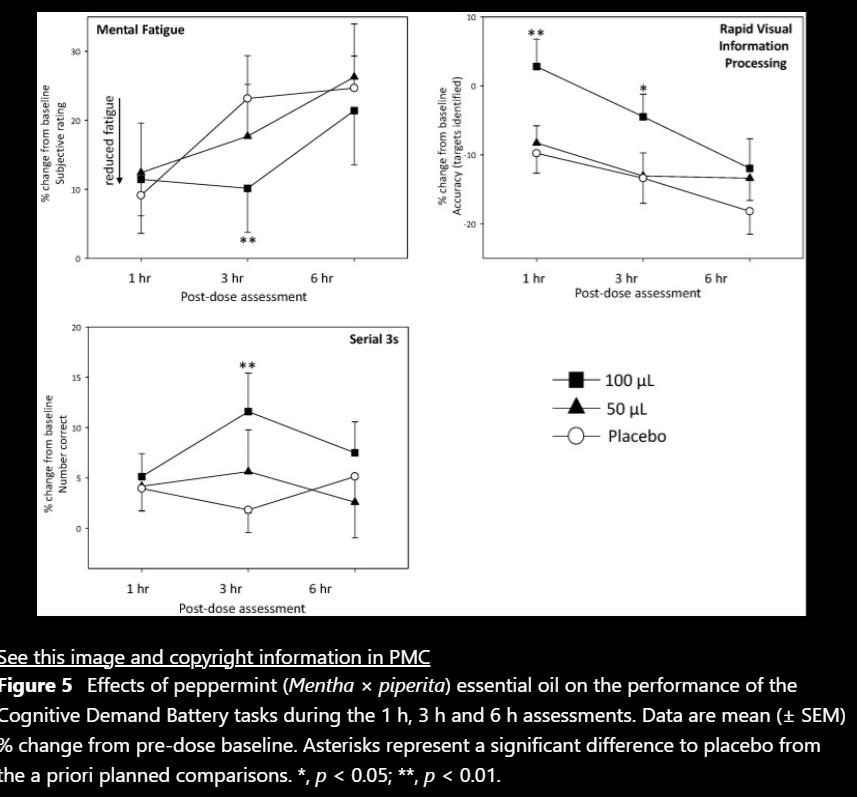
πŸ€“Study 1: involved consuming 1-2 drops of peppermint essential oil, and then evaluating both cognitive performance and fatigue at 1 and 3 hours after consuming the peppermint. Note the graph pic…… the 2 drops of EO had a profound effect, especially at the 3rd-hour mark.
πŸ€“Study 2: involved consuming 1 drop of peppermint EO and then exercising. Grip force, vertical and long jumps, blood pressure, heart rate, and breath rate were evaluated at 5 minutes and one hour. Compared to the placebo group, those who received peppermint oil had an average of 36.1% increase in grip force, 7% increase in standing vertical jump, and 6.4% increase in standing long jump. There was also considerable enhancement in the breathing of the peppermint group.
I’ll post links to each study in the comments. Both studies can also be found on the YL website under the “discover the research” button at the bottom of the Peppermint Vitality page.
Stay tuned for more peppermint factoids!
xoxo~ liz
#divingdeeperin2024
#thanksyl
#Godgaveuswhatweneedinthegarden
#peppermintwins

Conifer Tree Oils Stop The Crazies

Liz James · September 13, 2023 ·

🌲🌟Wednesday PSA 🌟🌲
For the nerdy inclined πŸ€“πŸ§ , here’s an interesting study: https://link.springer.com/article/10.1007/s00226-023-01490-6 (Title: Utilization of essential oils mainly from Cupressaceae trees in the work environment creates a psychophysiological stress-relieving effect. )
Β 
Recap:
🌲Study results suggest that certain conifer tree oils may help calm the crazy.
🌲Inhaling our “fir” friends may be beneficial in helping the body’s relaxation response. (We live way too often in the fight, πŸ₯Šflight,πŸƒβ€β™€οΈ or freeze😱 state of mind.)
Pro Tip: If the rest of your office (or home) tends to lean toward the cray cray meter, consider diffusing the situation. πŸ˜‰
xoxo~ liz
Β 
#ThanksYL
#appreciatingtrees
#BYOHD
#TakeChargeOfYourHealth
#takechargeofyourenvironment

Frequency Rocks!

Liz James · April 13, 2023 ·

Frequency and Singing Plants Epoch Times article

Frequency friends….. I’ve posted about singing plants before, and it appears our dear photosynthesizers are gaining traction in the music world. What are your plants saying to you? πŸ˜‰

Β 

America’s Diabetes Crisis: How to Detect and Prevent Type II Diabetes

Liz James · September 28, 2022 ·

diabetes prevention health coaching Liz James good medicine

America’s Diabetes Crisis: How to Detect and Prevent Type II Diabetes

There are times it’s not good to be Number One. This is one of those times. The United States is recognized as being among the nations with the best medical technology and the newest and best drugs. We spend more per person on healthcare than any nation in the entire world, so we should be among the healthiest, right? Yet, for all that we have, the USA has the worst health outcomes. We are #1 in diabetes, #2 in neurodegenerative diseases, #5 in cancer, and #6 in cardiovascular disease (source: Organisation for Economic Co-operation and Development).

Understanding Type II Diabetes Risk Factors

An estimated 1 in 3 American adults have prediabetes or metabolic syndrome (both are precursors to Type II diabetes). It’s a common but flawed thought that Type II diabetes only affects “fluffy” people. It doesn’t. There is a relatively new medical acronym called TOFI, which means “Thin on the Outside, Fat on the Inside,” and TOFI individuals can be just as much at risk as their fluffy counterparts. Lifestyle choices will always be the first line of defense to avoid acquiring a Type II diabetes diagnosis (or succeeding in backwalking out of one).

An astute detective will need some internal monitoring tools to more closely assess clues. Health thieves can be very stealth, and this is a reliable way to monitor gang movement before they leave visible gang “tags” (clues). Forewarned is forearmed! Think of this as another tangible aspect of your body’s security monitoring system.

Essential Tools for Monitoring Diabetes Risk

Here’s what you’ll need:

  • An at-home blood pressure cuff (every home should have one anyway!)
  • Know your waist circumference (measure at just above the hip bone, level with the belly button)
  • Know your family history. Remember that though genetics are important, they play less than a 10% role in outcome. Environment, lifestyle choices, and emotional tendencies control the other 90%. It’s important to know family history so that we can each be vigilant for what we suspect may be lurking in the shadows…. Knowing the health thief tendency (genetics) may be awaiting the right opportunity to steal, kill and destroy. I find a great deal of peace knowing that 90% of gene expression is fully under my own control!

Key Blood Tests for Diabetes Prevention

Get labwork annually which (at the very least) includes the following pieces of information:

  • Complete metabolic panel (CMP)
  • A basic lipid panel
  • Uric Acid and Homocysteine
  • Fasting insulin, fasting glucose, and HbA1c

The combined total of these tests will run about $250 well spent dollars out of pocket. If you have insurance, these are the tests to ask your doctor for when looking for a metabolic syndrome or prediabetes health thief.

NOTE: There is more labwork I’d suggest for a comprehensive look at the body from the inside out…. The above recommendation is specific for monitoring both prediabetes and metabolic syndrome.

Warning Signs of Metabolic Syndrome and Prediabetes

Signs of metabolic syndrome and prediabetes nearly always predate diabetic symptoms. Once you have your lab work, and have gathered your other tools, you’re ready to take a hard look at the state of the union of your body. Signs of metabolic dysfunction show up in the following ways:

  • Evidence of fatty liver
  • High blood pressure
  • High uric acid and homocysteine levels
  • High lipids in blood
  • High fasting insulin, HbA1c, and blood glucose

Understanding Your Blood Pressure Readings

Monitor your blood pressure. For a week, take it before you go to bed, and again before you get out of bed in the morning. If nighttime and morning blood pressure is higher than it should be, cut out all forms of sugar for a week, and retest. Sugar is highly inflammatory and often drives blood pressure upwards. Normal blood pressure runs 90-120 systolic (top number) and 60-80 diastolic (bottom number). High blood pressure is a symptom, not a root cause!

Waist Circumference and Diabetes Risk

An increased waist circumference (males should be under 40 inches and females should be under 35) is suggestive of inflammation, probable leaky gut, mitochondrial dysfunction, and insulin resistance.

Inflammation Markers to Watch

Uric acid and homocysteine are inflammatory markers. Levels are elevated if uric acid is over 5.5 mg/ml and homocysteine is over 10 umol/L. High uric acid levels lead to a fatty liver. Sugar is a big contributor to this. High homocysteine levels indicate an increased risk for developing heart disease and vascular inflammation. Methylated B12 and methylated folate, omega 3’s (OmegaGize3 is a great option), and optimized use of Vit D3 are all helpful tools in supporting healthy homocysteine levels.

Liver Health and Diabetes

Within your CMP, you’ll look for two numbers corresponding to AST and ALT. ALT is a liver enzyme which is fairly accurate for assessing fatty liver. If that number is over 25, more investigation is needed. AST is another liver enzyme. If it’s elevated (over 34) it may also indicate fatty liver (it also elevates when exposed to too much acetaminophen, alcohol, certain meds such as statins, and infection….. So do take that into consideration). If both are elevated, it’s definitely time to take a hard look at sugar and alcohol consumption.

Understanding Blood Sugar Metrics

Fasting glucose by itself is not enough, and sadly it’s often the only thing that is tested routinely. HbA1c is a window into the last 3 months of glucose control within the body. Fasting insulin indicates how well the pancreas is actually able to keep up. Optimally, fasting glucose should be 70-85 mg/dL, HbA1c should be less than 5.4%, and fasting insulin should be less than 6 uIU/mL.

Once you have those numbers, you’ll plug them into this equation: fasting glucose x fasting insulin divided by 405. Your answer to this equation is your assessed risk for developing diabetes. Less than 2.8 is excellent, 4.3 is average, and anything higher is a flag that mayhem is likely already occurring.

Cholesterol Indicators of Metabolic Health

When you are looking at your lipid panel, zero in on 3 different clues:

  1. The ratio of triglycerides to HDL. Studies have found that if this number is over 2.5 in the Caucasian population or 1.5 in the African American population, it tends to correlate with metabolic syndrome.
  2. HDL, the type of cholesterol that is considered “healthy” cholesterol. If it’s between 60-85, it’s generally a sign of good cardiovascular health. If the number is under 40 in men or under 50 for women, there is a greater chance of developing heart disease (a component of both metabolic syndrome and cohort of Type II diabetes). If the number is over 85, there’s a distinct possibility that HDL has a dysfunctional component.
  3. LDL cholesterol. If it’s between 100 and 300, look at your triglycerides. “If triglycerides are over 150, metabolic syndrome may be assumed until proven otherwise.” (Those wise words are from Dr. Robert Lustig MD and his brilliant book Metabolical)

15 Natural Ways to Prevent Type II Diabetes

Isn’t it prudent to avoid dark alleys and always lock your car? The same can be said for paying attention to these health clues. If the numbers above look like a dark avenue you’re not wanting to go down, here are some tips and tricks for avoiding shady areas!

  1. Cut back on carbs and sugar. Eat a low sugar high fiber diet. If you are not getting enough fiber in your diet, add YL’s ICP Daily, Balance Complete, or Power Meal to your nutrition world. Fiber helps regulate blood sugar levels by slowing down the release of glucose into the bloodstream.
  2. Avoid high fructose corn syrup like it’s the plague….. Because it is! It is a strong inducer of insulin resistance. When you start reading labels, you’ll be surprised at how many places it hides in plain sight.
  3. Avoid energy drinks that combine caffeine with fructose. That combination can aggravate insulin resistance and glucose intolerance. Use NingXia Nitro for a cleaner energy boost option. Try pairing Nitro with diffusing or wearing the essential oil blend En-R-Gee.
  4. Exercise regularly! Many studies have shown that weight loss and exercise can increase the body’s sensitivity to insulin.
  5. Improve your diet. A person will never be able to out run, out supplement, or out medicate a bad diet!
  6. Consider intermittent fasting. (If you are already on medication for diabetes treatment, you’ll want to talk to your holistically minded health professional before incorporating intermittent fasting into your routine). At the very least, stop eating 3-4 hours before your head hits the pillow at night.
  7. Know your labs, and don’t be afraid to ask for them by name!
  8. Watch your commercial dairy intake. There is a big difference between commercial pasteurized and homogenized dairy and raw dairy. The former is well known for the amount of inflammation it can cause within the body.
  9. Work towards decreasing inflammation within the body. Sulfurzyme not only helps support normal metabolic function within the body, it also helps regulate a more normal inflammatory response. It is one of my top five Young Living Supplements that I cannot imagine life without.
  10. Take an excellent highly bioavailable multivitamin such as Master Formula. Not all vitamins sold are bioavailable to the body.
  11. Incorporate insulin-modulating foods into your diet. Cinnamon, oat bran, fiber, ginger, barley grass (found in Multigreens), spirulina (found in Multigreens and NingXia Greens), chaga mushrooms, rosemary, green tea, cranberries, blueberries, lemon balm (Melissa), holy basil (tulsi), carrots, broccoli, asparagus, cauliflower, cucumbers, cabbage and salad greens. Healthy whole grain foods such as YL Einkorn products, quinoa, whole oats or oatmeal, and brown rice are also helpful, as are avocados, olive oil, and nuts and seeds. Cacao (natural chocolate) may also help regulate blood sugar levels according to a 2017 study.
  12. Try regular cold exposure which appears to help improve insulin sensitivity. Interestingly, Type II diabetes is positively associated with living in ambient temperature climates. Get your health care professional’s blessing if you have a medical condition (ex: high blood pressure or heart disease) that is being actively treated before partaking in cold showers, cold plunging, or cryotherapy.
  13. Monitor your iron and ferritin lab values: According to a few studies, it would appear that iron levels that are too high have been positively associated with insulin resistance.
  14. Consider adding turmeric to your routine. It has been found to be a helpful supplement to those who are taking the medication Metformin, and has supportive effects on blood glucose, oxidative stress and inflammation. (YL’s Golden Turmeric is my go to for a turmeric supplement!)
  15. Take key supplements including:
  • Vitamin B12 in the form of methylcobalamin to support healthy homocysteine levels
  • Antioxidants (NingXia Red and Super C) – A 2007 study in the Journal of Hypertension found that people who took adequate levels of Vitamin C had a 13% lower risk of developing diabetes
  • Magnesium – Approximately 75-80% of US residents are deficient in magnesium. A deficiency in magnesium sets the body up for both insulin resistance and gout (the official diagnosis for the painful symptoms of high uric acid levels in the body)

Additional Lifestyle Tips for Diabetes Prevention

  • Avoid toxins in daily living, especially atrazine (an herbicide commonly used on corn) and pesticides in general. Eat organically to avoid these.
  • Improve your sleep habits. Give up the night owl tendencies. Research has found that those who stay up late have a reduced ability to use fat for energy. When fat isn’t used appropriately in the body, it becomes fodder for health thieves. Work towards being in bed by 10pm.

There is so much more to prediabetes, Type II diabetes, and metabolic syndrome…..more than I could possibly write here. Hopefully though, I’ve given you food for thought and a desire to learn more. If so, do some digging and think outside the box! The more you know, the more health empowered you’ll be. We have full control of this part of our health story. How will you choose to write yours?

xoxo~ liz

blog about history of diabetes

#DiabetesPrevention #MetabolicHealth #PreventType2Diabetes #NaturalHealthTips #becomingyourownhealthdetective #BYOHD #thebestdefenseisagoodoffense #theapplicationofknowledgeisgoodmedicine #goodmedicine

  • Page 1
  • Page 2
  • Page 3
  • Page 4
  • Go to Next Page »

Book Your Health Coaching CallBook Now

Elizabeth James

469.425.9091

ebj0203@gmail.com