Thyroid Clues Part IV: Emotions, Feelings, and the Thyroid
Mind , body and spirit are so deeply interconnected that it is impossible to be robustly healthy if this triad is out of balance in any way. The “spirit” of what makes us ….”us” is a composite of beliefs, life experiences, relationships, and memories. Outwardly, this clue set may be exhibited to some small degree by our personality. Frankly though, an individual’s personality is the tip of the iceberg. What lies beneath the surface (feelings) always play a leading role in both sickness and health. No one holds the knowledge of your “submerged iceberg self” better than you, which is yet another reason why being your own CEO and chief health detective is so utterly important.
 , body
 and spirit
 are so deeply interconnected that it is impossible to be robustly healthy if this triad is out of balance in any way. The “spirit” of what makes us ….”us” is a composite of beliefs, life experiences, relationships, and memories. Outwardly, this clue set may be exhibited to some small degree by our personality. Frankly though, an individual’s personality is the tip of the iceberg. What lies beneath the surface (feelings) always play a leading role in both sickness and health. No one holds the knowledge of your “submerged iceberg self” better than you, which is yet another reason why being your own CEO and chief health detective
 is so utterly important.
Surely you’ve heard of people who have died of a broken heart. This phenomenon has been closely studied and acknowledged by science. Interestingly, we (as a society) tend to lean more into accepting the role of emotions and feelings in a death than we do the role personal belief and hope plays in an abundant life, and we certainly tend to overlook them (emotions and feelings) as responsible parties in health and wellness in day to day living.
 heart. This phenomenon has been closely studied and acknowledged by science. Interestingly, we (as a society) tend to lean more into accepting the role of emotions and feelings in a death than we do the role personal belief and hope plays in an abundant life, and we certainly tend to overlook them (emotions and feelings) as responsible parties in health and wellness in day to day living.
How does this fit into the puzzle of thyroid health? Quite well actually! Every organ and part of the body is affected at a cellular level by emotions, feelings, and memories, and learning to let go of that which doesn’t serve us is profoundly important in wellness and healing. The thyroid is, as you may recall, highly sensitive to changes in its environment. The “frequency” in which we “bathe” ourselves daily affects the health and performance of the thyroid. Frequency is not voodoo. It’s biology and physics. Everything (including our cells) is in a constant state of vibration, and any disease process will be evident as a disturbance in the structure and function of these frequencies. Positive emotions and feelings drive frequencies upwards (healthy), while negative emotions and feelings drive frequencies downwards (unhealthy).
 of thyroid health? Quite well actually! Every organ and part of the body is affected at a cellular level by emotions, feelings, and memories, and learning to let go of that which doesn’t serve us is profoundly important in wellness and healing. The thyroid is, as you may recall, highly sensitive to changes in its environment. The “frequency” in which we “bathe” ourselves daily affects the health and performance of the thyroid. Frequency is not voodoo. It’s biology and physics. Everything (including our cells) is in a constant state of vibration, and any disease process will be evident as a disturbance in the structure and function of these frequencies. Positive emotions and feelings drive frequencies upwards (healthy), while negative emotions and feelings drive frequencies downwards (unhealthy).
Emotions and feelings tend to get blended together, yet they are not interchangeable.
Emotions:
 They may manifest either consciously or subconsciously, and are a physical state or reaction to an event.They keep us alive! They are a primal response, and are deeply coded into our genetic being!They happen before feelings evolve about the event that occurred.They can be measured by facial expressions , body language, blood flow, racing heart, tightening of muscles, skin response, pupil dilation (etc)They generally last anywhere from a few seconds to an hour. Once the emotion has passed, the body returns to balance ( homeostasis).
Feelings are quite different.
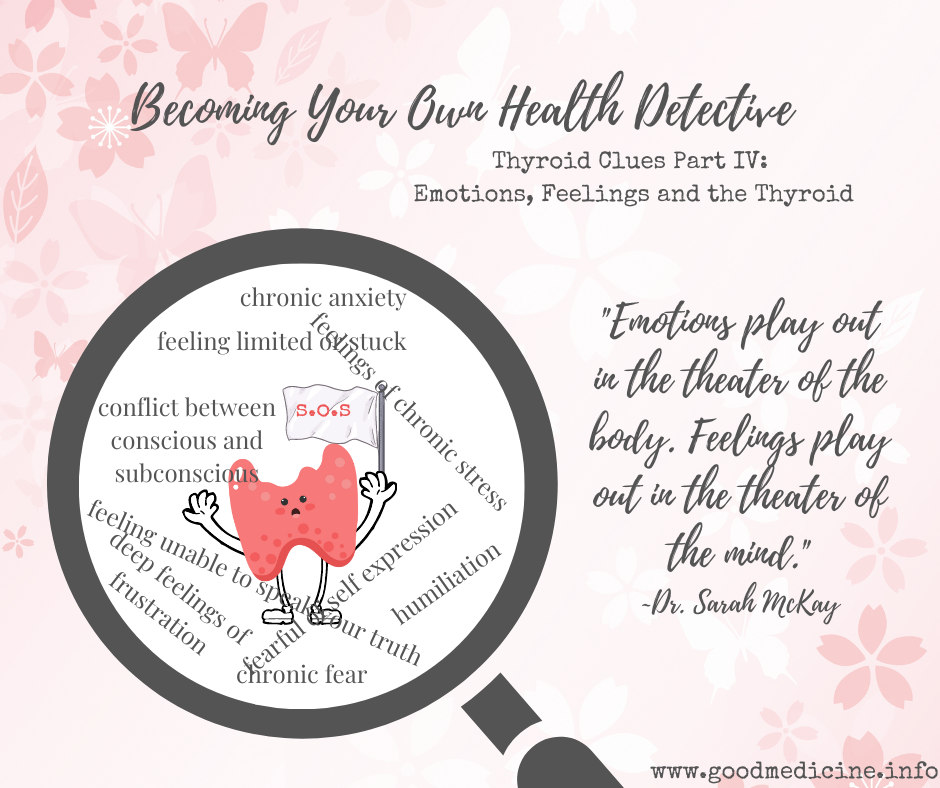
They are experienced consciously.They are a reaction (caused by emotions), and often influenced by personal experience, beliefs, and memoriesFeelings originate in the neocortical region of the brain (the home of conscious thought and separate from the limbic system which houses emotions ).Feelings form when your brain assigns a meaning to the emotional experience, and are mental interpretations of a situation.Feelings don’t drift off after an hour (like emotions do). They hang around because of a vast network of personal experiences, belief systems, and memories we hold individually.Ultimately, feelings are psychological responses while emotions are biological actions.The thyroid is the on location storage facility for some pretty hefty feelings. Some of these include:
 Conflict between the conscious and subconsciousFeeling limited or stuckStruggling with love of self or feeling unable to speak up for oneselfFeeling a need to be in total control or feeling out of controlFeelings of humiliationFeeling fearful of self expressionFeeling a deep sense of frustrationFeeling chronically fearful of anxious
Pairing the storage site (thyroid) with the lower vibrational frequency of harboring any of these negative feelings long term, and you may unearth a clue that has tremendous value in your thyroid health journey.
Now, what to do with this clue? There are a couple of valuable resources I’d like to point you towards:
Who Switched off my Brain? Controlling toxic thoughts and emotions by Dr. Caroline Leaf
And…..
The Pathway to Emotional Healing by Jen McCraw
These two books are extraordinarily valuable resources for healing the damage that stored negative feelings can inflict on the body. Doing “all the other things” (avoiding gluten, managing your iodine and other micronutrients, exercise, sleep hygiene etc etc etc) will never be enough if your spirit is not at peace.
Some of the essential oils you may consider when working towards healthy feelings (and subsequently, a healthy thyroid) as you nurture your spirit might include:
 Endoflex: supportive of mind, body (endocrine system) and spiritTransformation: supports feelings of positivity and self awarenessValor: supports feelings of courage and confidenceEnvision: supports feelings of creativity and resourcefulnessSurrender: supports the desire to let go of either too much control or uncontrollable behaviorsPeace & Calming: supports a positive peaceful atmosphere and mindsetSacred Mountain: supports feelings of strength and empowermentBelieve: supports and encourages feelings of faith and inner strengthRelease: helps facilitate the ability to let go of anything that no longer serves youCardamom, Pine, Myrtle, Frankincense, and Lavender are additional oils that are helpful in supporting healthy (thyroid affective) feelings and letting go of those which do not serve.
Oils are not magic friends. They are tools just as are the two books I’ve mentioned above. Neither the oils or the books will be helpful if they are bought and put on a shelf unused. The tools are there for the healer to use. YOU have the capability to be your own healer. It’s within you to do this. It’s hard work and it’s heart work, and you are worth the effort!

 magic friends. They are tools
 just as are the two books I’ve mentioned above. Neither the oils or the books will be helpful if they are bought and put on a shelf unused. The tools are there for the healer to use. YOU have the capability to be your own healer. It’s within you to do this. It’s hard work and it’s heart work, and you are worth the effort!
“Each patient carries his own doctor inside of him [or her!]. They come to us not knowing the truth. We are at our best when we give the doctor who resides within each patient a chance to go to work.” ~ Dr. Albert Einstein