• Skip to primary navigation
  • Skip to main content
Book Your Health Coaching Call
Good Medicine

Good Medicine

Holistic Health Coaching

  • Home
  • Liz James
    • About Liz
    • Coaching
    • Book a 20 Minute Complimentary Coaching Call
  • Favorite Resources
    • BlessedByHisBlood
    • Young Living
    • Fast Like A Girl Certified Coach
    • Order supplements through my Fullscript store
    • Green Pasture (Coupon: Health10)
    • RogersHood Apothecary (Coupon: BEABLESSING for 10% off)
    • DolphinMPS
    • Company
    • Abundance
  • My Books
    • Becoming Your Own Health Detective Volume 1
    • Becoming Your Own Health Detective Volume 2
  • Blog
  • Cart

Weight

Health Clues from Your Small Intestine

Liz James · May 18, 2021 ·

How much attention or thought do you put into your small intestine? Rarely do we hear much about this “small” organ. “Little things” can often be overlooked and in doing so, clues can easily be missed. Truly, the small intestine isn’t so very small….. It’s a 15-20 foot long digestion and absorption machine….. Usually overshadowed by its fore and aft kinsmen, the stomach and large intestine.. 


I relate to the small intestine as a middle child myself!😜  The stomach and large intestine have their individual strengths and frailties. While the small intestine has its own set of “responsibilities”, its wellbeing is greatly affected by sister stomach and brother colon.


If you’ll recall from last week’s chat about the stomach, having low stomach acid is not a good thing and may lead to some significant issues that literally drain into the small intestine. Have you ever heard of the term SIBO? It’s an acronym for Small Intestinal Bacterial Overgrowth, occurring when bacteria in the colon (large intestine) travels upwards into the small intestine where a relatively small amount of bacteria should be present on any given day thanks to stomach’s healthy acid content and cousin pancreas’s contribution of digestive enzymes! If either the stomach or colon (or both) don’t perform as they should, the small intestine will suffer.


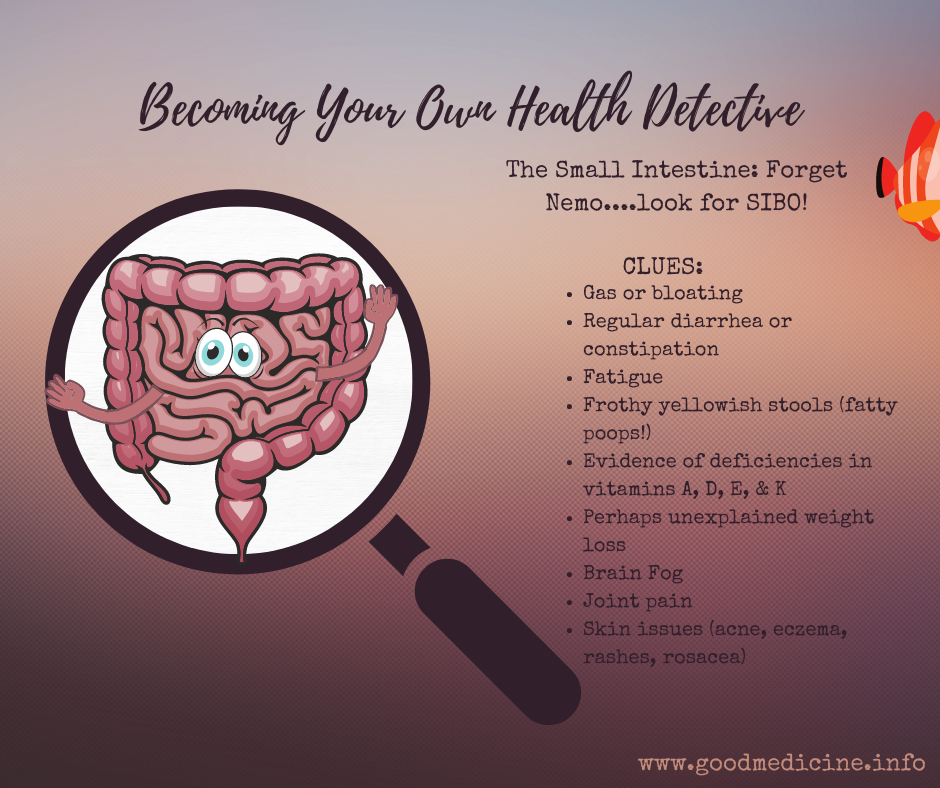
I’ve listed common clues of SIBO on the graphic.  None of them are drop dead urgent clues, right? Annoying, irritating, and perhaps even aggravating ….. but nothing that would cause an urgent SOS trip to your favorite health professional.
In a perfect digestive family environment, a healthy small intestine is a strong contributor to overall health. It facilitates absorption of some minerals (including sulfur, calcium, copper, iron, & zinc), fat soluble vitamins A,D,E &K, B vitamins, and Vitamin C. Small intestine also facilitates absorption of sugars, proteins, cholesterol, and bile salts.  It allows these nutrients to be absorbed all the while blocking foreign substances (ie: toxic “bullies”) from also being absorbed. If the small intestine walls become inflamed and damaged, it is unable to effectively discern between friend and foe, and bad influencers make it into the family body.


SIBO, if left unattended, contributes to:
🔥IBS, Diverticulosis, Crohn’s, Celiac, poor gut motility (greater than 75% have confirmed SIBO)
🔥Fibromyalgia  (78% have confirmed SIBO)
🔥Restless Leg Syndrome
🔥Interstitial Cystitis
🔥Diabetes
🔥RA, Scleroderma, and other autoimmune disorders
🔥Skin conditions
🔥Nutritional deficiencies
🔥Neuropathies due to deficiencies


In addition to poor stomach acid production, common contributors (aka lifestyle clues!!) to SIBO include: 
🔎Stress
🔎Poor diet (review what is typically known as the “Standard American Diet” / aka “SAD” indeed!)
🔎Mechanical issues (low stomach acid included here!)
🔎Antibiotic use (especially recurrent use)
🔎Regular use of acid reducers or proton pump inhibitors (ex: Nexium, Protonix, Prilosec)
🔎Opioid use (results in gut motility issues)
🔎NSAID use (ex: Ibuprofen, Naprosyn… damage the lining of the intestine)
🔎Gastric bypass surgery
🔎Moderate (or greater) alcohol use (est 90% have confirmed SIBO)
🔎Aging (due to decreased stomach acid and enzyme production)
🔎Long term colon dysfunction ( 78% of those with IBS have confirmed SIBO)


👉👉Note that while SIBO can be age related, it’s not uncommon to find it in children👦👧👶 who have chronic constipation/ diarrhea, have received antibiotics, are formula fed, or have received medication for reflux, or whose eating habits mirror the standard American diet.


It is estimated that 20-22% of the US population has some form of SIBO, and while there are ways to identify it through functional medicine testing, perhaps it may be more economical to simply identify existing physical and lifestyle clues, and then proceed towards alleviating the problematic areas.

 
❤️Showing the small intestine some love thru a healthy diet, adequate exercise, proper amounts of sleep are an excellent start! ❤️
Additional ways to support and love on the small intestine include:
❤️Consume 30-45 grams of soluble fiber daily (Hello Young Living ❤️Balance Complete Meal Replacement Shakes!)
❤️Digestive Enzyme supplements that contain Betaine HCl (Hello YL Essentialzyme caplets!)
❤️Probiotics (Hello YL Life 9 and for kiddos….. MightyPro!)
❤️Organic bone broth
❤️Olive leaf extract (Hello YL Olive Essentials capsules!)
❤️Young Living’s Peppermint, Caraway, Oregano, and Cinnamon Vitality essential oils. If you are a science hound, do some digging in pubmed.gov for a gold mine of information. If you are not a science hound, just know that these oils are your small intestine’s friends! 


Remember that our bodies are constantly giving us clues which buys time before “big things” generally happen. I’m so thankful that the body has the resilience and capability to restore itself to good health when clues are recognized and supportive measures are implemented. SIBO is a clue itself, indicating a potential downward spiral of the entire body at some point in the future if not addressed. 
Indeed…. Seemingly small things can often be important big ones! 
xoxo~ liz

#sharingiscaring
#digestivehealthclues
#healthcluesyoucanuse
#goodmedicine 
#findingSIBO

#ThanksYL
Breath Clues part 2

Liz James · March 23, 2021 ·


Becoming aware of HOW you breathe is important both as a health clue and an (inexpensive and valuable!) wellness tool. 


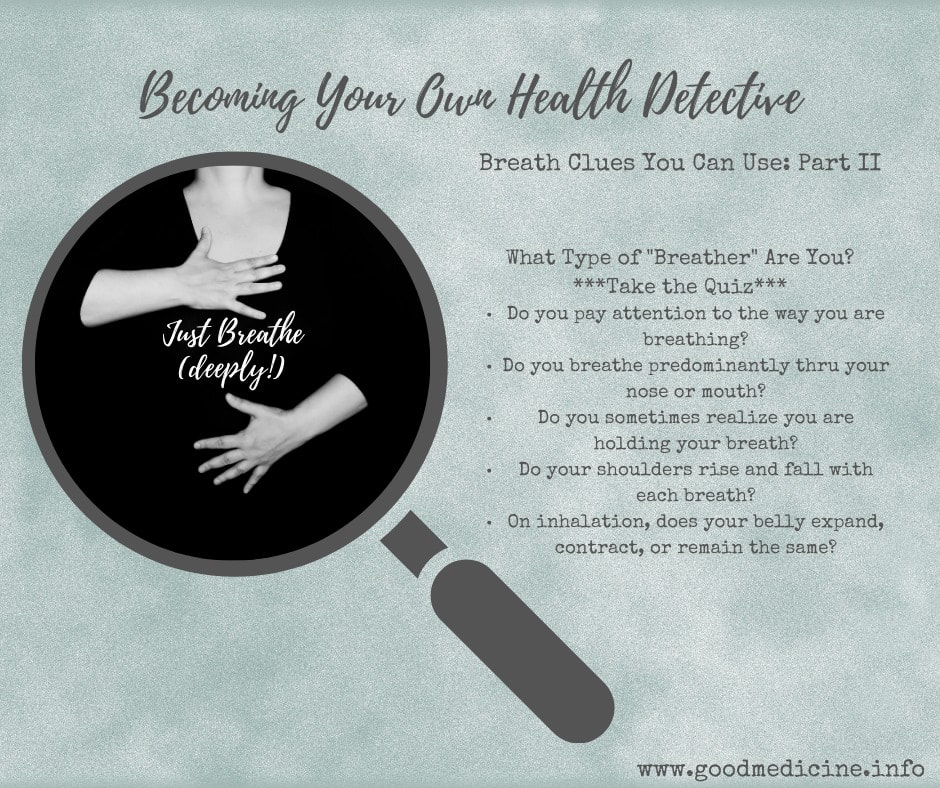
Did you take the quick quiz on the graphic?  If not, take a moment to do so!
Statistically, chronic shallow (mouth, neck, and upper chest) breathing is the most common type of breathing in Westernized cultures. This type of breathing  perpetuates stress and anxiety, activates the “fight or flight” (sympathetic response),  and suppresses the immune system. 


Conversely, diaphragmatic (deep belly) breathing balances the nervous system, supports heart health, improves circulation, promotes lymphatic drainage, reduces stress, calms the mind, and brings the body back into a more homeostatic state. 
Do you notice how some people remain calm, cool, and collected while others become a tightly wound spring with every stressor? The ability to pivot from “fight or flight” to “rest and digest” is incredibly important to health outcomes! ( Pharmacist tip: Learning to do this is helpful in keeping you away from the pharmacy!)  


The longest nerve in the body is called the  👉vagus nerve 👈. It runs from the brain thru the lungs and on to the gut, and affects every organ and body system it comes in contact with along the way ….. stomach, intestines, liver, gallbladder, heart, lungs, and the immune, endocrine, respiratory, and cardiovascular systems. In other words, the vagal nerve pathway is kind of a big deal! 😍


High vagal tone is incredibly important to overall health and wellbeing….. really, it’s a use it or lose it situation. Low vagal tone is associated with increased risk for cardiovascular disease, stroke, diabetes, GI disorders, and depression. Diaphragmatic breathing increases vagal tone! 


If deep belly breathing is not something you do on the regular (ie: it’s become second nature to you), Here are a few tips and tricks:
👉 Start with just 2 minutes several times a day. 
1. Place one hand on your upper chest and the other just below your rib cage, so you can feel your diaphragm move as you breathe.
2. Inhale deeply thru your nose for the count of 6-8 seconds (or 4-5 seconds if that’s too much)…. allowing your belly to expand. Try to fill your lungs with air. NOTE! The hand on your chest should remain as still as possible.
3. Slowly exhale through your nose for the count of 6-8 (or 4-5) drawing your belly button in and down as your abdomen moves inward.
4. As you breathe inward deeply, envision oxygen flowing inward and recharging your body. As you exhale, envision all the stress and tension leaving your body. 
5. Practice this for 2-3 minutes at a time (20-30 breath cycles). Graduate to 5 minutes as you are able! 


Scientifically noted benefits of diaphragmatic breathing can be further enhanced when you pair your breathing practice with Young Living essential oils known for their supportive roles in  health and wellness goals:
🌿Want to improve mood? Pair your practice with Citrus Fresh eo blend! 
🌿 Looking for better concentration? Try Brain Power or Frankincense!
🌿 Looking to better manage pain? (Yes, deep breathing helps with this too!) Add in PanAway or Deep Relief
🌿 Wanting to lower your blood pressure (Yep, deep breathing exercises does this too!)….. support happy vascular system breathing practices with Joy, Aroma Life, Ylang Ylang, or Lavender.
🌿Lowering blood sugar (amazing what regular deep breathing may do! Consider deep inhalations of Coriander, Melissa, or Christmas Spirit! 
🌿 Improve your sleep. Pair pre bedtime deep breathing with a diffuser loaded with Cedarwood, Orange, and Lavender! 
🌿  Use as a tool in your weight loss journey. Have you tried Grapefruit essential oil or Thieves on the bottom of the feet?
🌿 Strengthen the pelvic floor muscle (which will also improve bladder and bowel elimination function!). Consider pairing with Clary Sage, Cypress, or (Digize 👈 for colon support). 
🌿Better lymphatic flow?…. You’ll love Lemon essential oil (both regular and vitality!)! 


Noticing how you are breathing, and then making corrections as needed is a simple, but VIP wellness tool and health clue! Just as diaphragmatic breathing is helpful, chronic shallow breathing will exacerbate many health problems, and over time, may also contribute to lung infections and lung diseases.
Just breathe…… deeply! 
xoxo~ liz


👈 if you’d like to know more about additional breathing practices or the oils mentioned above, let’s chat!


#sharingiscaring 
#Godgaveusthetools 
#goodmedicineisgreatbreathinghabits
#goodmedicine Breath Clues: Part II
Becoming aware of HOW you breathe is important both as a health clue and an (inexpensive and valuable!) wellness tool. 
Did you take the quick quiz on the graphic?  If not, take a moment to do so!
Statistically, chronic shallow (mouth, neck, and upper chest) breathing is the most common type of breathing in Westernized cultures. This type of breathing  perpetuates stress and anxiety, activates the “fight or flight” (sympathetic response),  and suppresses the immune system. 
Conversely, diaphragmatic (deep belly) breathing balances the nervous system, supports heart health, improves circulation, promotes lymphatic drainage, reduces stress, calms the mind, and brings the body back into a more homeostatic state. 
Do you notice how some people remain calm, cool, and collected while others become a tightly wound spring with every stressor? The ability to pivot from “fight or flight” to “rest and digest” is incredibly important to health outcomes! ( Pharmacist tip: Learning to do this is helpful in keeping you away from the pharmacy!)  
The longest nerve in the body is called the  👉vagus nerve 👈. It runs from the brain thru the lungs and on to the gut, and affects every organ and body system it comes in contact with along the way ….. stomach, intestines, liver, gallbladder, heart, lungs, and the immune, endocrine, respiratory, and cardiovascular systems. In other words, the vagal nerve pathway is kind of a big deal! 😍
High vagal tone is incredibly important to overall health and wellbeing….. really, it’s a use it or lose it situation. Low vagal tone is associated with increased risk for cardiovascular disease, stroke, diabetes, GI disorders, and depression. Diaphragmatic breathing increases vagal tone! 
If deep belly breathing is not something you do on the regular (ie: it’s become second nature to you), Here are a few tips and tricks:
👉 Start with just 2 minutes several times a day. 
1. Place one hand on your upper chest and the other just below your rib cage, so you can feel your diaphragm move as you breathe.
2. Inhale deeply thru your nose for the count of 6-8 seconds (or 4-5 seconds if that’s too much)…. allowing your belly to expand. Try to fill your lungs with air. NOTE! The hand on your chest should remain as still as possible.
3. Slowly exhale through your nose for the count of 6-8 (or 4-5) drawing your belly button in and down as your abdomen moves inward.
4. As you breathe inward deeply, envision oxygen flowing inward and recharging your body. As you exhale, envision all the stress and tension leaving your body. 
5. Practice this for 2-3 minutes at a time (20-30 breath cycles). Graduate to 5 minutes as you are able! 
Scientifically noted benefits of diaphragmatic breathing can be further enhanced when you pair your breathing practice with Young Living essential oils known for their supportive roles in  health and wellness goals:
🌿Want to improve mood? Pair your practice with Citrus Fresh eo blend! 
🌿 Looking for better concentration? Try Brain Power or Frankincense!
🌿 Looking to better manage pain? (Yes, deep breathing helps with this too!) Add in PanAway or Deep Relief
🌿 Wanting to lower your blood pressure (Yep, deep breathing exercises does this too!)….. support happy vascular system breathing practices with Joy, Aroma Life, Ylang Ylang, or Lavender.
🌿Lowering blood sugar (amazing what regular deep breathing may do! Consider deep inhalations of Coriander, Melissa, or Christmas Spirit! 
🌿 Improve your sleep. Pair pre bedtime deep breathing with a diffuser loaded with Cedarwood, Orange, and Lavender! 
🌿  Use as a tool in your weight loss journey. Have you tried Grapefruit essential oil or Thieves on the bottom of the feet?
🌿 Strengthen the pelvic floor muscle (which will also improve bladder and bowel elimination function!). Consider pairing with Clary Sage, Cypress, or (Digize 👈 for colon support). 
🌿Better lymphatic flow?…. You’ll love Lemon essential oil (both regular and vitality!)! 
Noticing how you are breathing, and then making corrections as needed is a simple, but VIP wellness tool and health clue! Just as diaphragmatic breathing is helpful, chronic shallow breathing will exacerbate many health problems, and over time, may also contribute to lung infections and lung diseases.
Just breathe…… deeply! 
xoxo~ liz

#sharingiscaring 
#Godgaveusthetools 
#goodmedicineisgreatbreathinghabits
#goodmedicine 

Power to Heal – part 1

Liz James · September 15, 2020 ·

Modern medicine IS our friend. Make no mistake about that. Like humpty dumpty…. We cumulatively get “put back together again” about 234 million times a year (major surgeries). But that’s not all that goes down in the annals of modern medicine. An estimated 4.38 BILLION prescriptions 💊 get filled annually in the USA. ( 20 percent of Americans take at least 5 prescription drugs daily) 
That’s a bucket load of modern medicine for anyone’s book. Can too much of a good thing like modern medicine, be too much? 
Our world has turned into a place of “insta” ….-gram, -pot, -cart, -gratification, -weightloss,  etc. We want the “stuff” but not the work.
The pharmacy world has the capability to work that way too… “insta-relief”, “insta-I’mnotgonnadiefromabloodclot, “insta-birthcontrol” etc…..  BUT adopting a quick fix via pharmaceuticals for the long term solution will rarely end well for those who pursue it and make no effort to fix the root problems at hand. #thisiswhyIdowhatIdo
💊How can it possibly work for a diabetic who continues to destroy their body slowly with excess sugar and carbs, yet feels their disease is “under control” because they are medicated?
💊 What is someone’s muscularly weak spine going to look like in the long term…. When they opt for opioid or steroid pain relief instead of yoga, supplements that support proper inflammatory response, diet, and chiro or acupuncture care?
💊Medicating long term will ALWAYS come with side effects. Medications are built that way because they are imperfect. Side effects are most often the result of a caused deficiency from the very medication designed to “fix” something. What kind of deficiency you may ask? Well… that depends on the medication. It could be a vitamin, a mineral, a hormone, an enzyme…. Or even a multitude of these…. And sadly, THIS is not taught well in pharmacy, medical, or nursing school.  
💊Addictions…. According to web.md, roughly 20% of the US population has (or is currently) abusing prescription meds. It can happen so fast, and even to the best of people. I’ve seen it more times than I care to think about in my 30 years of pharmacy. Innocent addiction.
💊Antibiotic resistance…. Over use and improper use of antibiotics has led to this. The result? We have a LARGE problem on our collective hands…. Super bugs that are harder to kill.
Yes, we have definitely benefited from modern medicine. But just like anything else, is too much of a good thing possible in health care? You can bet your health savings account on it! 💰And is there anything we can do about it? You bet your insurance policy there is!  💰
 Stay tuned for part II!
xoxo~ liz
www.goodmedicine.info
#knowbetterdobetter 
#ThanksYL 
#halfthebattleisunderstandingtheproblem

Plant Power

Liz James · August 18, 2020 ·

I thought I knew which plant this essential oil comes from looked like. ( I was wrong.) So much for knowing what I thought I knew! 😜 But seriously, curiosity is important in the learning process.
Shall we play a game? 


🌿 This essential oil is available as both “regular” and vitality. (If you are unfamiliar with those terms, it means this particular oil may be diffused, taken internally (or cooked with), or used topically.
🌿 It comes from several different countries (none of which  is the USA)….. and was found to be used by the Egyptians in the mummification process. (Historically, it was highly valued for its varied uses)
🌿 Primary constituents (that which makes it an effective “tool” in our ‘at home’ wellness box) include :
Sabinene – known to support healthy inflammatory response and also create an unfavorable environment for fungus & wayward bacteria. Also a potent antioxidant
Beta-Caryophyllene –  also known for its strong support of a healthy inflammatory response, and a potent antioxidant.
Limonene- known for enhancing skin health, supporting kidney function, and also acts as a potent antioxidant.
🌿 This essential oil has been found to support and stimulate metabolism.
🌿 A study conducted in 2002 found that inhaling the fragrance from this essential oil induced a marked increase in plasma adrenaline concentration (ie = more energy!)


BENEFITS ENERGY AND METABOLISM AND SUPPORTS HEALTHY INFLAMMATORY RESPONSE……… THROWING IN A LITTLE PROTECTIVE “ATTITUDE” AGAINST FUNGUS AND WAYWARD BACTERIA…..
Who am I? 😎


Drop your guess in the comments!
#sharingiscaring
#alittleknowledgegoesalongway
#Godgaveusallweneedinthegarden
#ThanksYL

Winter Rest – part 1

Liz James · December 31, 2019 ·

Today’s the day we say goodbye to 2019, and while most are discussing plans to hit 2020 hard and heavy, I’d like to introduce a thought on behalf of your adrenal glands: consider allowing yourself some time this winter season to rest and recover.
YOU KNOW HOW WE POWERED THRU THANKSGIVING AND CHRISTMAS…..ALL THE WHILE SECRETLY WISHING WE COULD JUST CURL UP ON THE COUCH WITH A GOOD BOOK AND READ OURSELVES INTO A BLISSFUL WINTER’S NAP? IF YOU HAVE THAT FEELING, YOU’RE NOT ALONE…. THAT’S YOUR BODY TRYING TO TELL YOU SOMETHING. IT NEEDS TIME TO REST AND RECOVER FROM THE RAT 🐁 RACE! WE ARE NOT DESIGNED TO RUN 24/7/365.
❄️Winter is a time for fallen leaves, hibernation…. an energy reset. That’s an inaction not just reserved for nature! Prior to man-made electricity….. it was what we humans did too. We haven’t changed ya’ll….. allowing ourselves time to be still and quiet (ESPECIALLY in the Winter) will help boost internal health and go a long way towards setting the tone for your health in 2020.
❄️Winter is especially important for an adrenal gland / kidney / bladder reset. (Think water….. in the winter, water tends to slow down to a crawl…. especially if frozen).
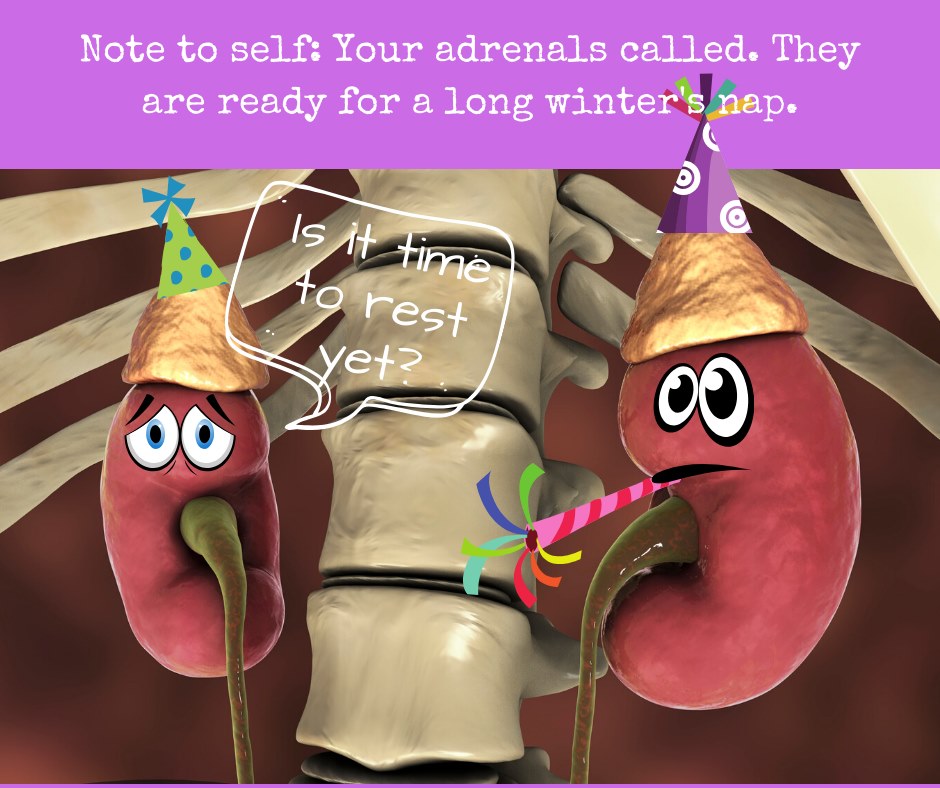
Our adrenal glands are the little party hat shaped organ that sit atop the kidneys. They produce the stress hormone cortisol….. an absolutely critical factor in regulating metabolism, and helping us “power thru”. Too much tho?….. and trouble begins to brew. The body cannot keep up. Dysregulation occurs, and adrenal fatigue may result.

🔥Common signs of adrenal fatigue: deep, long lasting exhaustion, water retention, weight gain, lack of motivation, depression/anxiety, brain fog, insomnia, feelings of chronic stress.🔥
The emotion of fear is based in the kidneys, and allowing chronic stress into your life will only guarantee a fear based emotional lifestyle. #lovenotfear
Stay tuned…. Part II is to come….. but in the meantime….. that bucket list for 2020?….. consider allowing time for a winter reset so that you don’t fizzle and can be all you are meant to be in 2020 with vibrant health! 😘
Hugs and Love xxooxx ~ Liz
#ThanksYL
#loveyouradrenalglandsandtheywillpayyou1000fold
#theresanoilforthattoo

  • « Go to Previous Page
  • Page 1
  • Page 2
  • Page 3
  • Page 4
  • Go to Next Page »

Book Your Health Coaching CallBook Now

Elizabeth James

469.425.9091

ebj0203@gmail.com