• Skip to primary navigation
  • Skip to main content
Book Your Health Coaching Call
Good Medicine

Good Medicine

Holistic Health Coaching

  • Home
  • Liz James
    • About Liz
    • Coaching
    • Book a 20 Minute Complimentary Coaching Call
  • Favorite Resources
    • BlessedByHisBlood
    • Young Living
    • Fast Like A Girl Certified Coach
    • Order supplements through my Fullscript store
    • Green Pasture (Coupon: Health10)
    • RogersHood Apothecary (Coupon: BEABLESSING for 10% off)
    • DolphinMPS
    • Company
    • Abundance
  • My Books
    • Becoming Your Own Health Detective Volume 1
    • Becoming Your Own Health Detective Volume 2
  • Blog
  • Cart

Weight

Health Clues in Your Colon part 2

Liz James · June 1, 2021 ·

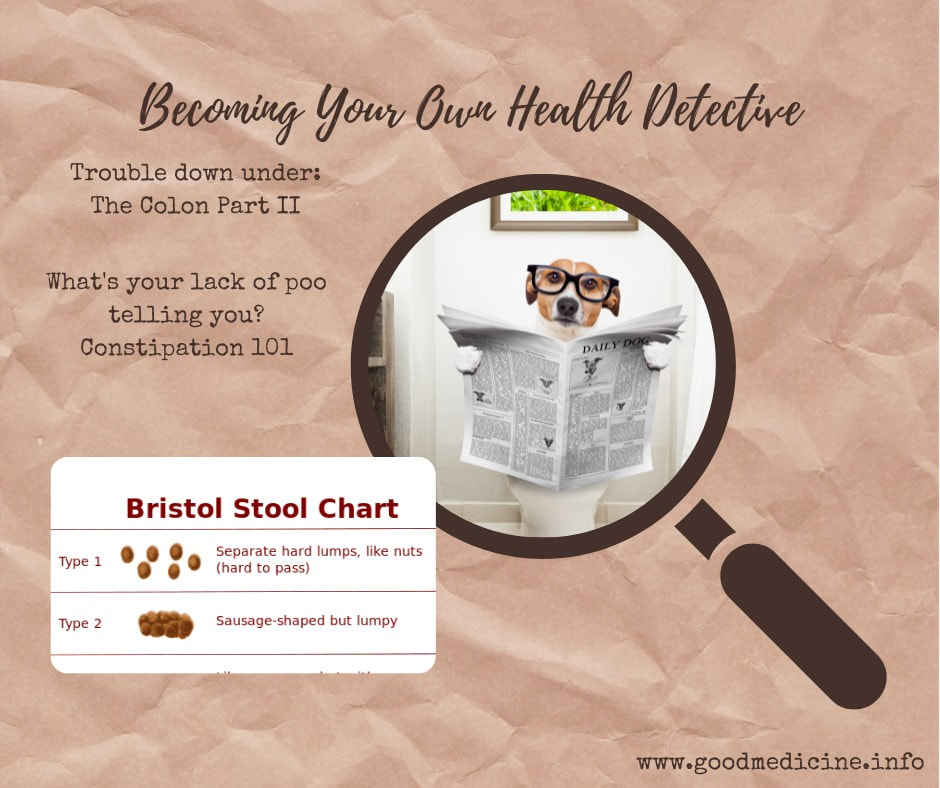
What’s your lack of poo 💩 telling you? Colon Part II
There’s no time like the present to start talking about poo, or in this chat…. lack thereof! Chronic constipation affects roughly 28% of the North American population if we abide by the western medicine general rule that it’s “okay” to have only 3 bowel movements a week. (No wonder we have so many chronic illnesses based on this information alone!😱)
Let’s flush that “3 times a week okay-ness”, and look at how an optimally healthy colon should be functioning.
Healthy gastrointestinal transit time should run somewhere between 12 and 24 hours…… optimally, 1💩 to 3💩💩💩 bowel movements a day help keep the toxin load of a body in check. What happens when the body’s toxin load grows due to lack of appropriate time on the throne? Sickness and dysfunction begin rearing their ugly heads in a variety of ways:
1. Weight gain – toxins stored in fat and it becomes increasingly difficult to lose weight.
2. Fatigue – metabolism is disrupted (yet another avenue of weight gain too!)
3. Skin irritation and rashes occur – we expel toxins thru poop, pee, breathing, and thru our skin. When pooping isn’t happening as it should, other organs often can’t keep up with the detox process either!
4. Headaches and migraines
5. Mood Swings
6. Joint and muscle pains and spasms
7. Insomnia
8. Increased or excessive sweating (the body is trying hard to shed the excess toxins!)
9. Constipation breeds an increased toxin load which leads to even more constipation!
Per statistics found on the National Institute of Health’s website, chronic constipation (THEIR version…. 3x/week pooping) accounts for over 5 million healthcare visits or hospitalizations per year, and over 5.3 million prescriptions written singularly for constipation.
These are large numbers☝️☝️, but imagine how much larger those numbers would be if they were to include not pooping daily and the subsequent results….(numbers 1 thru 8 above).
Constipation is a clue, and it’s also largely fixable with lifestyle changes. Oftentimes, if you fix constipation, other health concerns will also begin to quietly fix themselves! 😉
Low fiber eating habits (ie: processed foods), lack of gut microorganism balance (YL’s Life 9 is KEY here), lack of exercise, dehydration, certain medications (Opiates, some antidepressants, calcium channel blockers used to treat blood pressure and heart disease, medications used to treat Parkinson’s, Iron supplements, NSAIDS, diuretics, antihistamines are all known to cause constipation), a magnesium deficiency, hormonal fluctuations, hypothyroidism, SIBO (refer to earlier discussion) and even colon cancer are common contributors to constipation.
For most people, eating more whole fresh foods, exercising regularly, drinking plenty of quality water, and including a top notch probiotic food or supplement source (Did I mention Life 9 or MightyPro for the kiddos?) along with digestive enzymes (Essentialzyme, Essentialzymes-4, Detoxzyme, Allerzyme, or Mightyzyme for kiddos) will often solve the constipation conundrum.
For those who still need a little extra boost to get you on that throne consistently, consider adding in Young Living’s ICP (that acronym has been affectionately known to stand for “I see poop” amongst those who use it). #useittoloseit ICP is a powder (loaded with soluble fiber and other goodness) that is added to juice or smoothies, making it an easy addition to daily routine.
If constipation is something that plagues you, and you’ve tried #allthethings, it may be time to investigate possible food sensitivities, leaky gut syndrome, or severe gut dysbiosis (unbalanced gut bacteria) with the help of a health professional who is experienced working with patients in this demographic.
Happy flushing!
xoxo~ liz
#knowbetterdobetter
#healthcluesyoucanuse
#fixyourplumbing
#goodmedicine
#ThanksYL
Health Clues from Your Small Intestine

Liz James · May 18, 2021 ·

How much attention or thought do you put into your small intestine? Rarely do we hear much about this “small” organ. “Little things” can often be overlooked and in doing so, clues can easily be missed. Truly, the small intestine isn’t so very small….. It’s a 15-20 foot long digestion and absorption machine….. Usually overshadowed by its fore and aft kinsmen, the stomach and large intestine.. 


I relate to the small intestine as a middle child myself!😜  The stomach and large intestine have their individual strengths and frailties. While the small intestine has its own set of “responsibilities”, its wellbeing is greatly affected by sister stomach and brother colon.


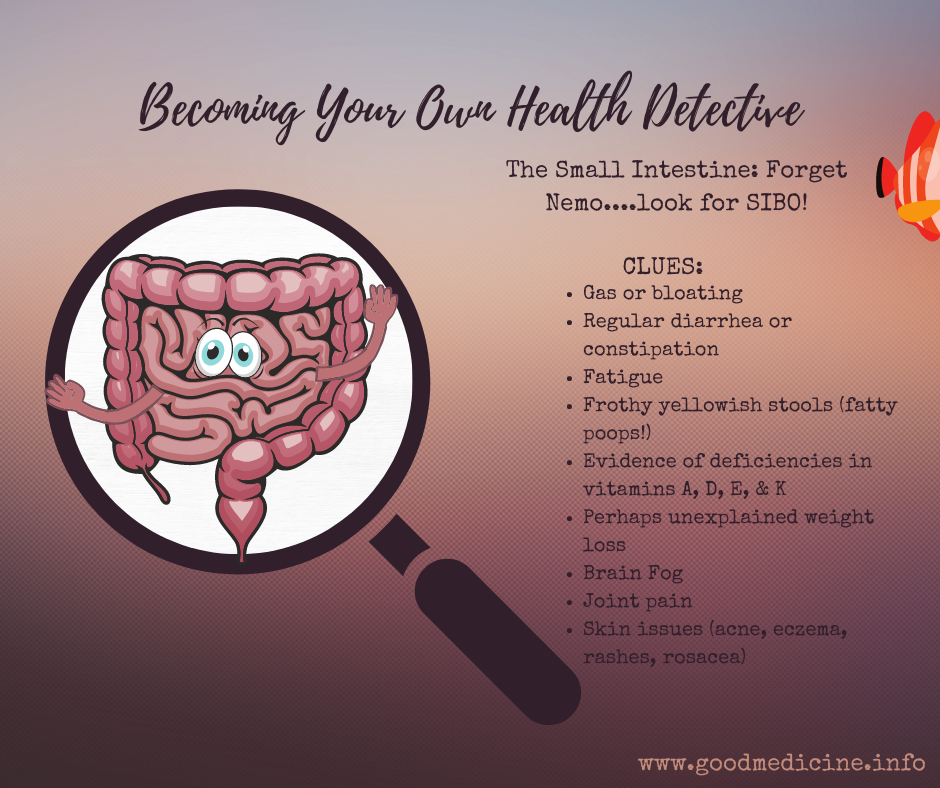
If you’ll recall from last week’s chat about the stomach, having low stomach acid is not a good thing and may lead to some significant issues that literally drain into the small intestine. Have you ever heard of the term SIBO? It’s an acronym for Small Intestinal Bacterial Overgrowth, occurring when bacteria in the colon (large intestine) travels upwards into the small intestine where a relatively small amount of bacteria should be present on any given day thanks to stomach’s healthy acid content and cousin pancreas’s contribution of digestive enzymes! If either the stomach or colon (or both) don’t perform as they should, the small intestine will suffer.


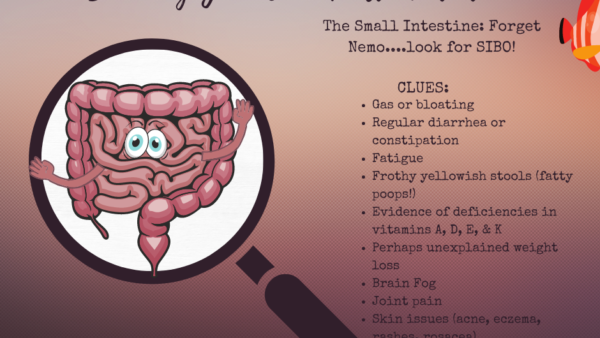
I’ve listed common clues of SIBO on the graphic.  None of them are drop dead urgent clues, right? Annoying, irritating, and perhaps even aggravating ….. but nothing that would cause an urgent SOS trip to your favorite health professional.
In a perfect digestive family environment, a healthy small intestine is a strong contributor to overall health. It facilitates absorption of some minerals (including sulfur, calcium, copper, iron, & zinc), fat soluble vitamins A,D,E &K, B vitamins, and Vitamin C. Small intestine also facilitates absorption of sugars, proteins, cholesterol, and bile salts.  It allows these nutrients to be absorbed all the while blocking foreign substances (ie: toxic “bullies”) from also being absorbed. If the small intestine walls become inflamed and damaged, it is unable to effectively discern between friend and foe, and bad influencers make it into the family body.


SIBO, if left unattended, contributes to:
🔥IBS, Diverticulosis, Crohn’s, Celiac, poor gut motility (greater than 75% have confirmed SIBO)
🔥Fibromyalgia  (78% have confirmed SIBO)
🔥Restless Leg Syndrome
🔥Interstitial Cystitis
🔥Diabetes
🔥RA, Scleroderma, and other autoimmune disorders
🔥Skin conditions
🔥Nutritional deficiencies
🔥Neuropathies due to deficiencies


In addition to poor stomach acid production, common contributors (aka lifestyle clues!!) to SIBO include: 
🔎Stress
🔎Poor diet (review what is typically known as the “Standard American Diet” / aka “SAD” indeed!)
🔎Mechanical issues (low stomach acid included here!)
🔎Antibiotic use (especially recurrent use)
🔎Regular use of acid reducers or proton pump inhibitors (ex: Nexium, Protonix, Prilosec)
🔎Opioid use (results in gut motility issues)
🔎NSAID use (ex: Ibuprofen, Naprosyn… damage the lining of the intestine)
🔎Gastric bypass surgery
🔎Moderate (or greater) alcohol use (est 90% have confirmed SIBO)
🔎Aging (due to decreased stomach acid and enzyme production)
🔎Long term colon dysfunction ( 78% of those with IBS have confirmed SIBO)


👉👉Note that while SIBO can be age related, it’s not uncommon to find it in children👦👧👶 who have chronic constipation/ diarrhea, have received antibiotics, are formula fed, or have received medication for reflux, or whose eating habits mirror the standard American diet.


It is estimated that 20-22% of the US population has some form of SIBO, and while there are ways to identify it through functional medicine testing, perhaps it may be more economical to simply identify existing physical and lifestyle clues, and then proceed towards alleviating the problematic areas.

 
❤️Showing the small intestine some love thru a healthy diet, adequate exercise, proper amounts of sleep are an excellent start! ❤️
Additional ways to support and love on the small intestine include:
❤️Consume 30-45 grams of soluble fiber daily (Hello Young Living ❤️Balance Complete Meal Replacement Shakes!)
❤️Digestive Enzyme supplements that contain Betaine HCl (Hello YL Essentialzyme caplets!)
❤️Probiotics (Hello YL Life 9 and for kiddos….. MightyPro!)
❤️Organic bone broth
❤️Olive leaf extract (Hello YL Olive Essentials capsules!)
❤️Young Living’s Peppermint, Caraway, Oregano, and Cinnamon Vitality essential oils. If you are a science hound, do some digging in pubmed.gov for a gold mine of information. If you are not a science hound, just know that these oils are your small intestine’s friends! 


Remember that our bodies are constantly giving us clues which buys time before “big things” generally happen. I’m so thankful that the body has the resilience and capability to restore itself to good health when clues are recognized and supportive measures are implemented. SIBO is a clue itself, indicating a potential downward spiral of the entire body at some point in the future if not addressed. 
Indeed…. Seemingly small things can often be important big ones! 
xoxo~ liz

#sharingiscaring
#digestivehealthclues
#healthcluesyoucanuse
#goodmedicine 
#findingSIBO

#ThanksYL

Breath Clues part 2

Liz James · March 23, 2021 ·


Becoming aware of HOW you breathe is important both as a health clue and an (inexpensive and valuable!) wellness tool. 


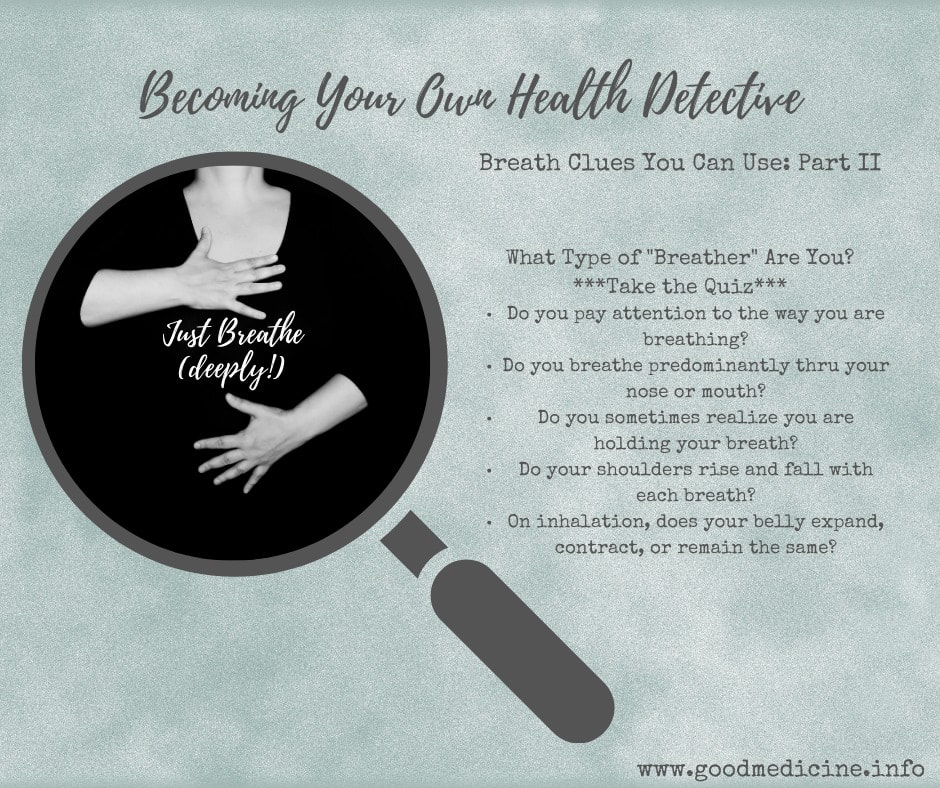
Did you take the quick quiz on the graphic?  If not, take a moment to do so!
Statistically, chronic shallow (mouth, neck, and upper chest) breathing is the most common type of breathing in Westernized cultures. This type of breathing  perpetuates stress and anxiety, activates the “fight or flight” (sympathetic response),  and suppresses the immune system. 


Conversely, diaphragmatic (deep belly) breathing balances the nervous system, supports heart health, improves circulation, promotes lymphatic drainage, reduces stress, calms the mind, and brings the body back into a more homeostatic state. 
Do you notice how some people remain calm, cool, and collected while others become a tightly wound spring with every stressor? The ability to pivot from “fight or flight” to “rest and digest” is incredibly important to health outcomes! ( Pharmacist tip: Learning to do this is helpful in keeping you away from the pharmacy!)  


The longest nerve in the body is called the  👉vagus nerve 👈. It runs from the brain thru the lungs and on to the gut, and affects every organ and body system it comes in contact with along the way ….. stomach, intestines, liver, gallbladder, heart, lungs, and the immune, endocrine, respiratory, and cardiovascular systems. In other words, the vagal nerve pathway is kind of a big deal! 😍


High vagal tone is incredibly important to overall health and wellbeing….. really, it’s a use it or lose it situation. Low vagal tone is associated with increased risk for cardiovascular disease, stroke, diabetes, GI disorders, and depression. Diaphragmatic breathing increases vagal tone! 


If deep belly breathing is not something you do on the regular (ie: it’s become second nature to you), Here are a few tips and tricks:
👉 Start with just 2 minutes several times a day. 
1. Place one hand on your upper chest and the other just below your rib cage, so you can feel your diaphragm move as you breathe.
2. Inhale deeply thru your nose for the count of 6-8 seconds (or 4-5 seconds if that’s too much)…. allowing your belly to expand. Try to fill your lungs with air. NOTE! The hand on your chest should remain as still as possible.
3. Slowly exhale through your nose for the count of 6-8 (or 4-5) drawing your belly button in and down as your abdomen moves inward.
4. As you breathe inward deeply, envision oxygen flowing inward and recharging your body. As you exhale, envision all the stress and tension leaving your body. 
5. Practice this for 2-3 minutes at a time (20-30 breath cycles). Graduate to 5 minutes as you are able! 


Scientifically noted benefits of diaphragmatic breathing can be further enhanced when you pair your breathing practice with Young Living essential oils known for their supportive roles in  health and wellness goals:
🌿Want to improve mood? Pair your practice with Citrus Fresh eo blend! 
🌿 Looking for better concentration? Try Brain Power or Frankincense!
🌿 Looking to better manage pain? (Yes, deep breathing helps with this too!) Add in PanAway or Deep Relief
🌿 Wanting to lower your blood pressure (Yep, deep breathing exercises does this too!)….. support happy vascular system breathing practices with Joy, Aroma Life, Ylang Ylang, or Lavender.
🌿Lowering blood sugar (amazing what regular deep breathing may do! Consider deep inhalations of Coriander, Melissa, or Christmas Spirit! 
🌿 Improve your sleep. Pair pre bedtime deep breathing with a diffuser loaded with Cedarwood, Orange, and Lavender! 
🌿  Use as a tool in your weight loss journey. Have you tried Grapefruit essential oil or Thieves on the bottom of the feet?
🌿 Strengthen the pelvic floor muscle (which will also improve bladder and bowel elimination function!). Consider pairing with Clary Sage, Cypress, or (Digize 👈 for colon support). 
🌿Better lymphatic flow?…. You’ll love Lemon essential oil (both regular and vitality!)! 


Noticing how you are breathing, and then making corrections as needed is a simple, but VIP wellness tool and health clue! Just as diaphragmatic breathing is helpful, chronic shallow breathing will exacerbate many health problems, and over time, may also contribute to lung infections and lung diseases.
Just breathe…… deeply! 
xoxo~ liz


👈 if you’d like to know more about additional breathing practices or the oils mentioned above, let’s chat!


#sharingiscaring 
#Godgaveusthetools 
#goodmedicineisgreatbreathinghabits
#goodmedicine Breath Clues: Part II
Becoming aware of HOW you breathe is important both as a health clue and an (inexpensive and valuable!) wellness tool. 
Did you take the quick quiz on the graphic?  If not, take a moment to do so!
Statistically, chronic shallow (mouth, neck, and upper chest) breathing is the most common type of breathing in Westernized cultures. This type of breathing  perpetuates stress and anxiety, activates the “fight or flight” (sympathetic response),  and suppresses the immune system. 
Conversely, diaphragmatic (deep belly) breathing balances the nervous system, supports heart health, improves circulation, promotes lymphatic drainage, reduces stress, calms the mind, and brings the body back into a more homeostatic state. 
Do you notice how some people remain calm, cool, and collected while others become a tightly wound spring with every stressor? The ability to pivot from “fight or flight” to “rest and digest” is incredibly important to health outcomes! ( Pharmacist tip: Learning to do this is helpful in keeping you away from the pharmacy!)  
The longest nerve in the body is called the  👉vagus nerve 👈. It runs from the brain thru the lungs and on to the gut, and affects every organ and body system it comes in contact with along the way ….. stomach, intestines, liver, gallbladder, heart, lungs, and the immune, endocrine, respiratory, and cardiovascular systems. In other words, the vagal nerve pathway is kind of a big deal! 😍
High vagal tone is incredibly important to overall health and wellbeing….. really, it’s a use it or lose it situation. Low vagal tone is associated with increased risk for cardiovascular disease, stroke, diabetes, GI disorders, and depression. Diaphragmatic breathing increases vagal tone! 
If deep belly breathing is not something you do on the regular (ie: it’s become second nature to you), Here are a few tips and tricks:
👉 Start with just 2 minutes several times a day. 
1. Place one hand on your upper chest and the other just below your rib cage, so you can feel your diaphragm move as you breathe.
2. Inhale deeply thru your nose for the count of 6-8 seconds (or 4-5 seconds if that’s too much)…. allowing your belly to expand. Try to fill your lungs with air. NOTE! The hand on your chest should remain as still as possible.
3. Slowly exhale through your nose for the count of 6-8 (or 4-5) drawing your belly button in and down as your abdomen moves inward.
4. As you breathe inward deeply, envision oxygen flowing inward and recharging your body. As you exhale, envision all the stress and tension leaving your body. 
5. Practice this for 2-3 minutes at a time (20-30 breath cycles). Graduate to 5 minutes as you are able! 
Scientifically noted benefits of diaphragmatic breathing can be further enhanced when you pair your breathing practice with Young Living essential oils known for their supportive roles in  health and wellness goals:
🌿Want to improve mood? Pair your practice with Citrus Fresh eo blend! 
🌿 Looking for better concentration? Try Brain Power or Frankincense!
🌿 Looking to better manage pain? (Yes, deep breathing helps with this too!) Add in PanAway or Deep Relief
🌿 Wanting to lower your blood pressure (Yep, deep breathing exercises does this too!)….. support happy vascular system breathing practices with Joy, Aroma Life, Ylang Ylang, or Lavender.
🌿Lowering blood sugar (amazing what regular deep breathing may do! Consider deep inhalations of Coriander, Melissa, or Christmas Spirit! 
🌿 Improve your sleep. Pair pre bedtime deep breathing with a diffuser loaded with Cedarwood, Orange, and Lavender! 
🌿  Use as a tool in your weight loss journey. Have you tried Grapefruit essential oil or Thieves on the bottom of the feet?
🌿 Strengthen the pelvic floor muscle (which will also improve bladder and bowel elimination function!). Consider pairing with Clary Sage, Cypress, or (Digize 👈 for colon support). 
🌿Better lymphatic flow?…. You’ll love Lemon essential oil (both regular and vitality!)! 
Noticing how you are breathing, and then making corrections as needed is a simple, but VIP wellness tool and health clue! Just as diaphragmatic breathing is helpful, chronic shallow breathing will exacerbate many health problems, and over time, may also contribute to lung infections and lung diseases.
Just breathe…… deeply! 
xoxo~ liz

#sharingiscaring 
#Godgaveusthetools 
#goodmedicineisgreatbreathinghabits
#goodmedicine 

Guilty or Innocent? Weighing in on Cholesterol

Liz James · March 4, 2019 ·

Cholesterol has been heavy on my heart for the last month… haha! No pun intended there… my cholesterol is actually fine….. but I tend to root for the the misunderstood and the underdog when given a choice. (That’s probably why our farm tends to be a haven for rescue dogs and cats…. but I digress!) 

Did you know that approximately 80% of people with acute cornary syndrome….(ie: reduced blood flow to the heart… often leading to heart attack) have NORMAL cholesterol values? What’s up with that? 

Cholesterol is one of those underdogs. Bless its sticky little heart….. it’s given a bad rap more so than nearly any other body produced compound. What would we do without cholesterol?  That’s a good question…. I’m not entirely sure any of us would be around to discuss it if we lacked it in our bodies! It is a major component of cell membranes and is a necessary building block for hormones, fat soluble vitamin D, and bile salts (aiding in the digestion of fats and fat soluble nutrients). Cholesterol is also extremely important to the function of our nervous system. Without it, we’d be bumbling malfunctioning idiots….especially considering that our brains are roughly comprised of 50% cholesterol. So why all the hate?

Our bodies are efficient producers of cholesterol…. producing about 80% of what is in our bodies (the other 20% comes from dietary sources). Cholesterol should not be confused with Triglycerides (perhaps the real bad boys), or the obscure thug that likes to hang on to its buddy LDL….. lipoprotein(a).

Unpacking Cholesterol: The cholesterol in our vascular system is a mixed bag of good and bad. HDL (the good guys) has the job of bouncer…. and it escorts out the shadier gang members, LDL, from our bloodstream. LDL comes in a variety of sizes…. and the smaller sizes (subunits 3 & 4) are really bad news. The bigger ones (subunits 1 &2) are fluffier and are actually pretty helpful. Because they (subunits 3&4) are small, they can easily work their way into the lining of our arteries where the bouncer (HDL) can’t reach them. In a whopping 20% of the population (1 in 5) there is something called Lipoprotein(a) that makes LDL ‘extra sticky’….. if you carry this genetic characteristic, it is best to know about it early on in life, as it dramatically increases your risk for clogged arteries and  blood clots leading to strokes and heart attacks. It is a serious health risk, and frankly…. should be tested for at least once in everyone’s life.
While managing total cholesterol with careful eating habits (avoid processed and ‘fast’ foods) is important, …. the real culprits we should be monitoring are inflammation, triglycerides, and lipoprotein(a).


Triglycerides are produced predominately by the liver. When we eat, the body stores any excess calories as triglycerides in our fat cells. It is particularly fond of doing this with carbs. Later…. between meals…. hormones will signal a need for more energy, and those triglycerides will be released. Herein lies the rub tho….. if you eat more than you exert energy, triglycerides begin building up and you end up with hypertriglyceridemia (HTG), and THAT my friends, is cause for alarm. Even if someone has verified genetic HTG, management can be achieved with responsible ownership of the vessel you reside in:

  • Daily physical activity
  • Conscious consuming of healthy fats… avoiding processed foods and other sources of “bad fats”
  • no smoking
  • Optimizing body weight
  • Limit processed sugar intake to no more than the equivalent of 6 teaspoons of sugar per day. (The average North American consumes about 200gms or 48 teaspoons of processed sugar in their diet daily)
  • Work towards optimal triglyceride lab values of <100 and a triglyceride to HDL ratio of 1:1 to 2:1. 

Lipoprotein(a) is no joke. 73 million people in the USA are estimated to be living with this ‘sticky’ situation. It is extremely dangerous because the molecule itself is so small, sticky, and it difficult to manage. What makes it even more dangerous is this: most insurance companies refuse to pay for the test that determines if you have it….. and many doctors don’t even mention the test to patients because insurance doesn’t pay. I have not been able to wrap my brain around the logic of NOT paying for a potentially life saving test…. but there you have it. It’s just one more reason to take charge of your own health and ask for the test and pay for it out of pocket, ESPECIALLY if you have family history of heart disease. Nothing….. no vacation, no daily coffee, no new phone…. should be more valuable to you than knowing this information about yourself. Once you know, you have the power to act…. and that can change the trajectory of your life. If you do carry this genetic trait, you will want to have your children tested. They need to learn healthy habits early in life. It’s never too young to become a CEO of oneself!

IF you have inherited lipoprotein(a), you’ll want to pay very close attention to what you CAN do, because it’s time to take your health seriously. Some people do not get a warning, and find themselves diagnosed at the same time their mortality is realized. Lp(a) requires close attention and monitoring. Tools to help in management include: 

  • Daily baby aspirin
  • High quality Omega3 fish oil…. lots of it… has been found to lower Lp(a)LDL by approximately 10%. (Poor quality Omega 3’s become oxidized and can actually do more damage than taking nothing at all. Know your supplement company…not just their name, but how they do business. This is especially important with Omega 3’s.) Omegagize3 from Young Living!
  • High doses of Niacin (1-3 gms/day) … the flushing kind (ex: Slo-Niacin)… have been found to lower Lp(a)LDL by up to 30%
  • Maintain a fasting blood glucose of <100
  • Vitamin C @ 3000mg/day
  • L-lysine, L-proline & L-carnitine in high doses (L-carnitine helps make lp(a) less sticky)
  • Test for and maintain hs-CRP (high sensitivity c reactive protein) at <1. This measures inflammation in the body and high levels are a risk factor for heart attack.
  • Control blood pressure ideally at 120/70.
  • Consistent exercise
  • Abstain from smoking
  • Get (regularly) an Advanced Lipid Panel every 6 months w/ the following goals:
  1. LDL< 60
  2. Triglycerides < 60
  3. LDL particle # < 700

I realize this has been kind of a heavy post. I’m sorry about that. It’s a heavy topic tho. Most people (even healthcare professionals) don’t have a clear understanding of exactly what causes the real problems in our vascular system. Hopefully, you can see that cholesterol itself is not the real monster….. it’s actually pretty awesome stuff. Too much of a good thing is bad tho…. no matter what it is. Although I only barely touched on inflammation in this post, it’s HUGELY important to this topic too. Sticky Lp(a)LDL is especially fond of a chronically inflamed vascular system.

It is my hope and blessing that this helps someone better manage their own health, and to prompt personal responsibility one’s own health. I am not a doctor. Information here is for recommendation purposes only, and not intended to substitute for specific medical advice. Please do use this information as a starting point for your own research, and use as discussion points with your personal healthcare provider.

Love and hugs,  Liz

​

​

  • « Go to Previous Page
  • Page 1
  • Page 2

Book Your Health Coaching CallBook Now

Elizabeth James

469.425.9091

ebj0203@gmail.com