
• Skip to primary navigation
  • Skip to main content
Book Your Health Coaching Call
Good Medicine

Good Medicine

Holistic Health Coaching

  • Home
  • Liz James
    • About Liz
    • Coaching
    • Book a 20 Minute Complimentary Coaching Call
  • Favorite Resources
    • BlessedByHisBlood
    • Young Living
    • Fast Like A Girl Certified Coach
    • Order supplements through my Fullscript store
    • Green Pasture (Coupon: Health10)
    • RogersHood Apothecary (Coupon: BEABLESSING for 10% off)
    • DolphinMPS
    • Company
    • Abundance
  • My Books
    • Becoming Your Own Health Detective Volume 1
    • Becoming Your Own Health Detective Volume 2
  • Blog
  • Cart

Uncategorized

Risks to Birth Control Pills

Liz James · March 18, 2022 ·

I’m often learning alongside you. This is how we grow, right? I’ve not been a fan of birth control pills for many years. Unfortunately, I did not know the truth about them in the 80’s and early 90’s when I took them as a way to manage my own severe endometriosis. When I woke up to the hand that fed me (my pharmacy license / Big Pharma ) in the late ’90’s, BCP’s was one of the rabbit holes I ventured down… and am still venturing down because there is soooooooo much to understand about this class of medications. Physically, socially, historically, and politically (and it’s all tied together 🙄🥴. #ofcourseitis )
 
The story of “green plasma” 😬was new to me tho. As I said….. always learning 🤓. And now I’ve got another book to buy so I can learn more details. 😀
 
With Big Pharma, things are rarely as they seem on the surface.
 
Before taking any medication, take the time to dig deeper than what the label (or your pharmacist) says. Most pharmacists have not done their due diligence on learning the truth. They are given talking points by their employer, the insurance companies, and the drug manufacturers.
 
We research when we buy a car, a computer, or any other impactful purchase….. why would you not do this for something life altering like a long term medication and weigh risk versus benefit. You are worth it.😘
 
xoxo~ liz
 
#sharingiscaring
#greenplasma 😳
#knowingthetruthaboutBCPsisgoodmedicine
#riskvsbenefitalways
#becomingyourownhealthdetective
 
PS: Note the payout (1.02$Billion for clots and $21 million for gallbladder…. no small potatoes!) in lawsuits related to just two birth control brands [there are more] made by one company (Bayer….. who also happens to own Monsanto….. who also happened to play a large role within the Nazi atrocities committed during WWII https://encyclopedia.ushmm.org/content/en/article/bayer.)

 
https://www.theepochtimes.com/why-do-few-women-know-the…

The Curious Case of Covid and the Shrinking Brain

Liz James · March 16, 2022 ·

Long Covid. Have you heard of it? Maybe perhaps you’ve even experienced it yourself. Those who have experienced it appear to have a variety of symptoms. Headaches, disrupted concentration, anxiety, brain fog, longstanding smell or taste disturbances are common complaints. Occasionally, even psychosis is mentioned.

These brain changes are now physiologically accounted for according to a recent study in the journal, Nature. Inflammation of both the blood vessels and nervous system tissue are noted as probable culprits. I agree with that, but I also believe there are likely other factors involved. One of those factors is the micro-clotting that has been identified as a byproduct of a covid infection. Micro-clotting is an interesting creature and in my personal estimation, it is not getting nearly the attention that it should be getting.

Exchange of oxygen for carbon dioxide occurs at the capillary level. Likewise, the exchange of toxins for nutrients from the blood to tissue also occurs at the capillary level. Micro-clotting wouldn’t necessarily cause issue at the larger vessel level (arteries and veins), unless there was a snowball effect of the micro-clots.

My boots on the ground theory is this: If micro-clotting inhibits the mission of the capillaries (to exchange trash for treasure) in the body, what happens? That particular tissue will pay a price. Toxins will accumulate and starvation and slow asphyxia will occur….likely not enough to cause death, but certainly discomfort. As the body starts to feel the effects of this, the subconscious will probably notice first and anxiety will be ramped up, feeling like it’s coming from “nowhere”.

The longer tissue is starved and deprived, the more dramatic the long game. What happens when the body is deprived of what it needs? It shrinks. It comes as no surprise to me that the brain is affected. I’ve worked with several people who have had long covid symptoms, and in my personal experience, there are ways to alleviate and perhaps even reverse the problem.

  1. Reduce inflammation (as the article states)
  2. Open the blood vessels up a bit more with a mild herbal vasodilator
  3. Increase the blood’s ability to “slip” a little more easily within vessels
  4. Use natural gentle products to decrease the body’s hospitality to spike proteins.
  5. Do all of this on a daily basis.

If someone is already on certain medications, there are some contraindications, but overall, it’s a pretty safe method. As always too…… if you keep adding in toxins (commercial household cleaners, bodycare products, toxin laden makeup etc) in your daily grind and only try to fix things by adding things in, the response will be slower. The body doesn’t lie about its state of affairs.

xoxo~ liz

Dopamine Deficiency -part 2

Liz James · January 24, 2022 ·

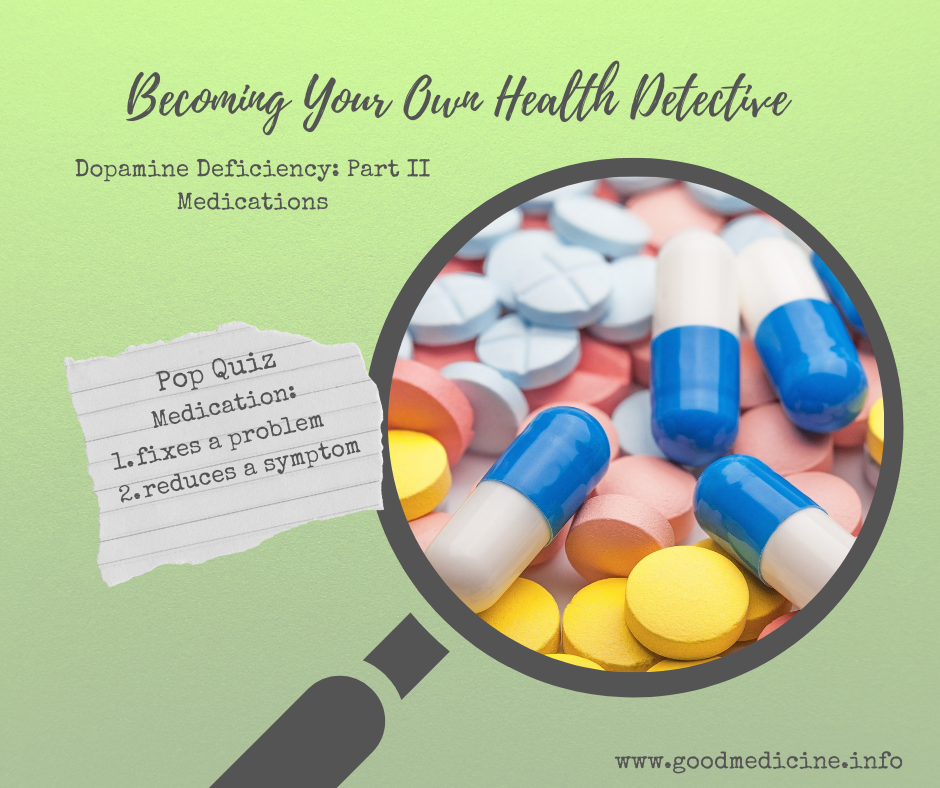
Dopamine Deficiency Part II: The Medication Connection

When the topic of substance abuse is broached, the neurotransmitter dopamine is often brought into the conversation. Recalling our earlier discussion, dopamine contributes to feelings of pleasure and satisfaction and directly influences the way our brain achieves happiness by “guiding” our behavior to get to that feeling. Heroin, cocaine, and MDMA (ecstasy) are three of the bigger illicit guns that initially trigger a surge of dopamine in the body. Sugar also induces a massive (but short lived) dopamine surge. The body is filled with protective mechanisms (thankfully!), and if dopamine surges continue, a mechanism will kick in that reduces the number of dopamine receptors available for triggering. Consequently, it becomes harder and harder to achieve the same feelings of pleasure. As you may have already guessed, common opioid prescription medications do this too especially when used chronically. Some offenders would include:
💊Hydrocodone
💊Codeine
💊Tramadol
When you review the introduction to dopamine deficiency (see Part I), you’ll notice that neurodegenerative conditions, chronic back pain, aches and pains, and persistent constipation are symptoms of deficiency. Those are also four very common complaints in people who use these pain medications chronically. Certainly, other factors are involved as well (do some digging!), but dopamine deficiency plays a significant role.
Dopamine sabotage by way of medication💊 is also an unfortunate common side effect of drugs that block dopamine binding to receptor sites. When a medication does this, dopamine cannot “do its work” in the body.
💊Haloperidol is used to treat schizophrenia, Tourettes, and severe behavioral problems in children and adults.
💊Risperidone is used to treat schizophrenia, disinterest in life, strong or “inappropriate” emotions, or disturbed thinking.
💊Metoclopramide is used to treat GERD, nausea/ vomiting, and slowed gut motility.
💊Olanzapine, Aripiprazole, Quetiapine are used to treat schizophrenia, bipolar disorder, and depression.
💊Buspirone is used to treat anxiety.
🧐If you were to pick up and read a package insert on each of these medications, you would find side effects listed giving evidence of dopamine deficiency (refer to Part I for symptoms).
What I write next might be the most technical and one of the most important concepts to understand in this entire book, so stay with me…. even if the slogging feels uphill! According to the National Institute of Mental Health (NIMH), an estimated 1 in 5 adults have a mood disorder in the USA. Sadly, when prowling around the NIMH website, I found very little in the way of suggesting lab work to rule out a hormonal, thyroid, or nutrient imbalance, or selfcare suggestions (clean diet, well developed exercise routines, tips on improved sleep hygiene, or connecting with a high frequency community, and most importantly, having a personal relationship with God). The website is quick to advocate for mental health medicating. Go figure.
💊Selective Serotonin Reuptake Inhibitors (SSRI’s) are a class of drugs used to treat depression, anxiety, and other mood disorders. Common SSRI’s include 💊Citalopram, 💊, Fluoxetine, 💊Paroxetine, and 💊Sertraline. By definition, this class of drugs is supposed to be “selective” in their mechanism of action, and while they are marketed as products that raise serotonin in the brain, they simultaneously lower dopamine levels significantly. Additionally, there is very strong evidence that, depending on the individual and the SSRI used, there may be a significant effect on the HPA (hypothalamus, pituitary, adrenal) axis in the brain, where cortisol, hormones (including serotonin and dopamine) are regulated and long term memories are stored. The hypothalamus and the pituitary play a significant role in regulating the thyroid. You may imagine how important all of this is in balanced overall body and brain function.
I offer this information to you as clues, not as medical direction or individualized medical advice. Risk versus benefit should always be first and foremost whenever utilizing a medication, especially one that modulates “motherboard” (brain) activity. I read one doctor’s thoughts recently who described antidepressant use as a “sledgehammer to repair a fine watch.” Does the tool fit the need? That is only for you and your healthcare provider to decide.
Last week, I listened to a podcast that dovetailed into this topic. It is called “Unscientific Diagnoses Medicalize Normal Human Experience”. I’ve posted a link to this 30 minute podcast below. You won’t regret listening to it. We must get back to living in tightly knit communities where we love and care for one another well while also learning that experiencing emotions in a healthy manner is part of vibrant living. I’m so very very thankful for Young Living, because we exemplify that community, and there is plenty of room at the table for everyone who wants to #knowbetteranddobetter for themselves and their families.

We live in a broken world that is bandaged by a broken medical system. I encourage you to use your finely tuned tools for finely tuned processes in the body. Whenever possible, leave the sledgehammer in the shed.
Next week, I’ll discuss readily available inexpensive tools to help support optimal dopamine levels.
Until then~
xoxo, Liz

#caringissharing
#knowbetterdobetter
#dopamineisdope
#balanceddopamineisgoodmedicine
#goodmedicine
#BecomingYourOwnHealthDetective
#ThanksYL

(If you answered #2, you’d be correct!)

unscientific Diagnoses Medicalize Normal Human Experiences
  • « Go to Previous Page
  • Page 1
  • Page 2
  • Page 3

Book Your Health Coaching CallBook Now

Elizabeth James

469.425.9091

ebj0203@gmail.com