Dotting your i’s and crossing your t’s: Iodine and Thyroid Part I
We all know that iodine is a necessary micronutrient and plays an important role in the health of the thyroid. I’m pretty confident that getting to know your individual iodine level (as I hope you will be encouraged to pursue by the end of this series ) is going to be new clue territory for many people.
 ) is going to be new clue territory for many people.
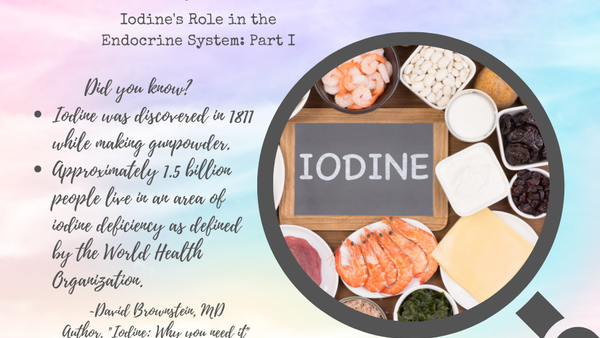
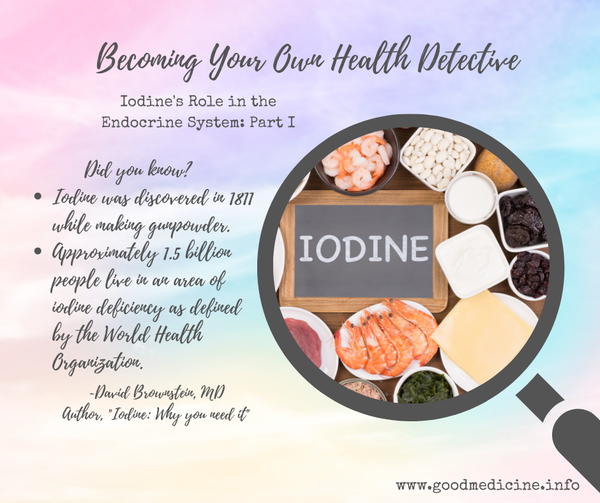
Iodine is not commonly found in soil and therefore not found appreciably in many foods. So how are we to get it into our bodies? It is found in ocean foods such as ocean fish and crustaceans and sea vegetables (seaweed), but it would require a regular diet of these foods to prevent a deficiency.


 and sea vegetables (seaweed), but it would require a regular diet of these foods to prevent a deficiency.
History of iodine related problems:
In the early 1900’s, goiters were a health concern in many inland areas where seafood wasn’t a common food source. In 1923-1924 a study revealed that simply adding small amounts of iodine to the diet drastically decreased the incidence of goiters. Iodized salt was introduced into the US market, and by 1951, fewer than 0.5% of school aged children had evidence of enlarged thyroid glands. (Previously, it had been a remarkable 40% in areas with little access to ocean foods). The United States Food and Nutrition Board eventually set the RDA for iodine between 150-290 micrograms/day (approximately ½ – ¾ tsp iodized salt) to prevent goiters.
wasn’t a common food source. In 1923-1924 a study revealed that simply adding small amounts of iodine to the diet drastically decreased the incidence of goiters. Iodized salt was introduced into the US market, and by 1951, fewer than 0.5% of school aged children had evidence of enlarged thyroid glands. (Previously, it had been a remarkable 40% in areas with little access to ocean foods). The United States Food and Nutrition Board eventually set the RDA for iodine between 150-290 micrograms/day (approximately ½ – ¾ tsp iodized salt) to prevent goiters.This is all fine and dandy, except that there are a few missing pieces to the puzzle. The RDA was set up to prevent goiters (which it does quite well), but is the recommendation adequate for optimal thyroid, immune system, and endocrine function?
Consider these facts:
 The Japanese consume 89 times more iodine than Americans (waaaaaaay more than what the US RDA has established) due to daily consumption of sea vegetables. Coincidentally, the traditional Japanese culture has reduced rates of chronic disease and some of the lowest cancer rates worldwide.Iodine is considered to be among the safest of all essential trace elements (provided we are discussing the inorganic non radioactive
 variety!), yet it has been given some pretty strict guidelines by the entities in charge.Iodized salt is loaded with sodium which has its own health concerns. Additionally, a 1969 study
  found the bioavailability of iodine in iodized salt to be only about 10%.An estimated 50% of adults in the United States have an undiagnosed iodine deficiency, and some of the researchers and “out of the box thinking” experts I follow suggest that this number may be as high as 90%.When I consider how often “those who make the rules” have given us dubious health information in other areas of health, I usually opt to think for myself. Yes, I acknowledge the guidelines, but I also dig for evidence that there may be some rocks “they” don’t want us to look under.
 It’s an established fact that we are monetarily worth more to the medical system if we are dependent upon it.
So, back to the question…..are we getting enough iodine to be optimally healthy?
Let’s dive a little deeper into the iodine fact pool:
Scientifically, iodine has been proven to have antibacterial, antiparasitic, antiviral, and anticancer properties. Iodine is responsible for regulating thyroid function and supporting healthy metabolism.Adequate Iodine is necessary for a robust immune system.Every cell in our body has a life cycle. When a cell dies in a healthy body, it is replaced by a new cell. This programmed cell death is called apoptosis, and it’s a good thing. Cancer cells are examples of cellular failure to undergo apoptosis. Iodine plays an important role in this beneficial programmed cell death.Iodine has a protective effect against H. Pylori  (a bacteria that tends to live in the stomach, and when overpopulated, causes ulcers and stomach cancer)Iodine is a key ingredient for the production of all of the other hormones in the body. (Did you catch that….. “All” ). It’s also found in every cell in our body, but especially concentrated in the salivary glands, the substantia nigra of the brain (one of the involved areas for Parkinson’s disease), the cerebral spinal fluid, the gastric mucosa, breasts, ovaries, and the ciliary body of the eye.Would you find it interesting that iodine deficiency has been linked to many chronic diseases and dysfunctions including Multiple Sclerosis, glaucoma, Sjogren’s, Parkinson’s, thyroid disorders, fibrocystic breast disease, breast, ovarian, endometrial and prostate cancer, uterine fibroids, ovarian cysts, certain headache types, diabetes, heart arrhythmia, and the inability to detox properly especially when exposed to mercury, fluoride, and bromine.
Iodine Robbers
In this crime scene, we definitely have clues pointing to a robber or two that can further deprive the body of iodine:
 Iodine is an interesting micronutrient. It’s categorized as a “halide” on the periodic table. As a halide, it hangs out with the likes of fluorine, chlorine, and bromine. As you might guess, there are enough similarities between these four that iodine, fluoride, chlorine, and bromine often compete with one another in the body. It’s like a chemical version of the movie “The Parent Trap”
 , and fluoride, chlorine, and bromine compete against iodine preventing absorption and binding and tricking the body in the process. Larger degrees of exposure to these toxins make it harder for the body to use the iodine we do get in our diets and supplements. Hopefully you’ve kicked that fluoride laced toothpaste and mouthwash to the curb and have fallen in love with Young Living’s Thieves toothpaste and mouthwash. Watch your water sources for fluoride and chlorine too. Remember, the skin is like a sponge!
Bromine may not be a toxin you’ve heard much about. Unfortunately, that’s not because it’s rare. Bromine is used commonly in pesticides used on fruits (eat organically!), and is found in various processed foods and vegetable oils, hair dyes, textile dyes, commercial cosmetics (use your Savvy Minerals!), pool and spa chemicals, flame retardants, and paints.
Medications including maalox, mylanta, amiodarone, anti-gout meds, birth control pills, cortisone and prednisone as well as some SSRI’s inhibit the body’s use of iodine. Note the possible drug-disease causing connection, especially when there is long term use of the pharmaceutical.Even certain foods can be iodine robbers if eaten in excess. Cabbage, broccoli, spinach, Brussel sprouts, cauliflower, kale, radishes, mustard greens, strawberries, and peaches may cause issues ( only if eaten in excess), especially if iodine levels are already low.Can you get too much iodine? Does everyone need more iodine? How does taking thyroid medication affect iodine deficiency? Next week, we’ll talk about a couple ways to help determine your iodine status and answer these questions. In the meantime, if you think now’s a good time to add a little extra kelp into your world, Young Living’s Master Formula and Thyromin both contain this VIP sea veggie!
xoxo~ liz
(PS: Becoming Your Own Health Detective, Volume One is still on sale at presale prices through the end of this week. Link to purchase: https://goodmedicine.info/my-book/ )
 temperature it’s generally in relation to illness or fertility. You’ve heard people say, “My body temperature just runs low.”, and we accept that as “normal” for them. Heck, I was one of those people too, until I learned the truth.
 I promise to keep it simple. Understanding these principles will help seal this information into your memory.
 Temperature is an indicator of heat in a system.
 Dr. David Jernigan writes, “The colder a body becomes, the slower the electrical oscillatory rate and therefore the thicker, more viscous, or syrupy the body fluids become. The more viscous the fluids become the more difficult it is for the body to push the fluids through the body. The lymph fluids that are normally supposed to bathe the outsides of all of your cells become progressively stagnant as it is too thick to move efficiently.”
 You bet it can, and we’re going to discuss that next week!
  Remember, the wall around Jerusalem didn’t get destroyed in a single day and it wasn’t rebuilt in a single day either! And, Nehemiah didn’t do it alone. He sought out a community of like minded people with different skill sets to help him rebuild, and they persevered… even despite toxic (both physical and emotional) onslaught in the process. Your life is a story of clues, and although God is the ultimate author of each of our stories, the choices we make play a huge part in the writing of it!

 Dopamine Deficiency Part IV: More Solutions
 ,
,  Mowing the yard! It may be hard work, but the aroma of fresh cut grass contains a chemical called hexanal (the “green” smell of grass) that stimulates dopamine release.
 Organic coffee (No more than one cup a day or it may contribute to adrenal fatigue…. A dopamine high followed by a crash!) or a cuppa organic green tea (Have you tried the YL
  Acupuncture stimulates the vagus nerve, which in turn support healthy dopamine levels. (Go back and reread the section on low vagal tone!)
 Creating and performing music boosts dopamine levels even more than listening to your favorite tunes, but all three are effective. Listening to music has even been shown to improve fine motor skills in Parkinson’s patients.
 Chronic inflammation reduces dopamine synthesis and release in the brain. We’ve got tools on hand to support a healthy inflammatory response (as opposed to the runaway variety!).
  Lack of sleep down regulates dopamine receptors and reduces dopamine receptor availability. You know what to do! Sleep is so very important in ALL aspects of health. Review your sleep hygiene practices and look for “holes in the armor” that may result in interrupted sleep. I LOVE and incorporate
 Vitamin C assists with the formation and conversion of dopamine in the brain. Deficient levels of vitamin C may show up as a low mood.
  Vitamins B6 and B9 are critical for dopamine synthesis. Low folate levels contribute massively to low dopamine levels which may ultimately lead to depression.
  Alternate between standing and sitting. “Chronic sitting” lowers dopamine levels. Our body was designed to move!
 Finish a project. Who knew? This in itself causes the brain to flood with dopamine.


 Do you recall what set your tilted health world
 upright and spinning in the right direction again? Was it DiGize,
  Thieves for the win!
  . While you were sighing with relief, didn’t you also want to shout from the roof tops? I frankly couldn’t keep my mouth shut. Everyone needed to know about the miraculous ways of Young Living plant juice.
 that keeps on giving! Because it’s February….. (and you don’t want to miss Lucy Li Bido’s class that starts today!….. you’re going to want the tools to make her potions
  )
)  ) It has been used for centuries in ointments and salves for skin, including dressing battle wounds of soldiers. If you see a recipe for Frank but don’t have it on hand, Elemi does a stellar job as your backup plan! Have a great Feb 1st friends! It’s going to be an amazing month! (Holler if you’d like a 10% coupon to get started….. I’ll have a few to give away this month!)