
Analysis Paralysis has finally released its hold on me as I dip into the complexities of thyroid dysfunction and their absolute connection with autoimmune disorders. It’s important to understand that over 90% of diagnosed hypothyroid patients actually have an autoimmune disorder.
History always helps me understand science and biology because history leaves valuable clues. A journal article I read yesterday had this interesting tidbit:
“During the first half of the century [1900’s], autoimmune disease was viewed as biologically implausible.”
My, how things have changed! Resistance to the idea that autoimmunity could not happen began waning in the 1960’s. By then, life had changed drastically in many ways. Processed foods were introduced into mainstream eating habits, medication / vaccination use steadily inched upwards into the norm rather than the exception, plastics became part of our everyday world, fluoride was added to water, personal care products had a growing ingredient list of words that were barely pronounceable, herbicides were used ubiquitously and parents let their kids run behind the trucks that were spraying DDT for mosquitoes! Thankfully the DDT spraying has stopped, but other pesticides quickly took its place. The toxin list has grown by leaps and bounds over the decades. Today, our bodies have to wade through the toxic soup known as the standard American life. Genetically, we haven’t changed appreciably, yet we are now part of the sickest generation in recorded history.
 Resistance to the idea that autoimmunity could not happen began waning in the 1960’s. By then, life had changed drastically in many ways. Processed foods were introduced into mainstream eating habits, medication / vaccination use steadily inched upwards into the norm rather than the exception, plastics became part of our everyday world, fluoride was added to water, personal care products had a growing ingredient list of words that were barely pronounceable, herbicides were used ubiquitously and parents let their kids run behind the trucks that were spraying DDT for mosquitoes
 ! Thankfully the DDT spraying has stopped, but other pesticides quickly took its place. The toxin list has grown by leaps and bounds over the decades. Today, our bodies have to wade through the toxic soup
 known as the standard American life. Genetically, we haven’t changed appreciably, yet we are now part of the sickest generation in recorded history.
Did you know that at least 90% of genetic expression is the result of our environment, while the other 10% can be attributed to the role of the proverbial parental genetic dice? Epigenetics (the expression of our genes based on environmental influences) will look differently for each person based upon genes + exposure to infection (often viral), the Standard American Diet (simultaneously nutritionally deficient and toxic), pollutants (both in and outside the home), medications/vaccines, emotions, and stress. Epigenetics is so specifically unique to an individual that even identical twins may express genes differently when exposed to chronic stressors. If you are going to put together a perfect crime scene, this is the way to do it!
 may express genes differently when exposed to chronic stressors. If you are going to put together a perfect crime scene,
 this is the way to do it!
Roughly 20% of the adult population in the USA now has an autoimmune disorder
And this percentage continues to rise. Prior to the 1970’s, autoimmune disorders were relatively obscure. Hashimoto’s, the autoimmune version of hypothyroidism, is considered by The Autoimmune Registry to be the second most common of all autoimmune disorders (second only to rheumatoid arthritis).
There is both bad and good news about autoimmune disorders. While they never disappear, they can certainly go into remission with the right lifestyle changes and choices. It’s a good thing we are in control of our personal choices!

According to leading Hashimoto’s and autoimmune disorder expert, Dr. Datis Kharrazian, there are 3 stages of autoimmune disease:
Stage One is the silent stage. The body has begun losing its tolerance to its own tissue, but to the western health practitioner, there will be very few “hard core” symptoms. You though, as the CEO and chief sleuth , will feel “off”. What does “off” feel like? Well, that depends! It may be something as subtle as spending more (or less!) time in the bathroom. Perhaps it might be a rash that comes and goes. Maybe it means you are having difficulty finding the zest for life you once had, or you just have a little harder time waking up in the morning or falling asleep at night. Stage One is very important, as catching “things” early can be a game changer in the outcome. Lab work identifying elevated TPOAb and TGAb antibodies (for Hashimoto’s) can be very revealing. Neither test is very expensive when you pay out of pocket. Sadly, insurance companies often refuse to pay for these as “maintenance” labs. If your request is refused, I highly encourage you to pay out of pocket elsewhere and have the tests run annually with other labs.Stage Two is considered the reactivity stage and actual destruction to target tissue has begun. Symptoms are much “louder” and harder to ignore inside your own body. In fact, it may be this stage that finally sends you to a healthcare practitioner, though you’ve felt “off” for perhaps even years.In Stage Three, westernized medicine officially acknowledges the autoimmune disease. Significant destruction of the targeted tissue has occurred and there may even be collateral damage occurring elsewhere throughout the body. At this stage, damage can be seen by an MRI or ultrasound in addition to the elevated antibodies and actual symptoms.
Interestingly, the level of antibodies detected doesn’t necessarily indicate the severity of the Hashimoto’s. The antibodies themselves do not cause the thyroid gland destruction. Without getting too technical, the antibodies bind to and mark the spot (ie: the thyroid), and then the T Cells ( think of them as a special forces unit of the immune system) come in and attack what the antibodies have marked as “foreign”. If your own personal set of T cells are especially aggressive, your antibody count can be low but destruction of the thyroid can still be severe. Likewise, if your T cells act more like lazy posers, your TPOAb’s can be high but destruction probably won’t be as severe as you might think. Again…. epigenetics at play.
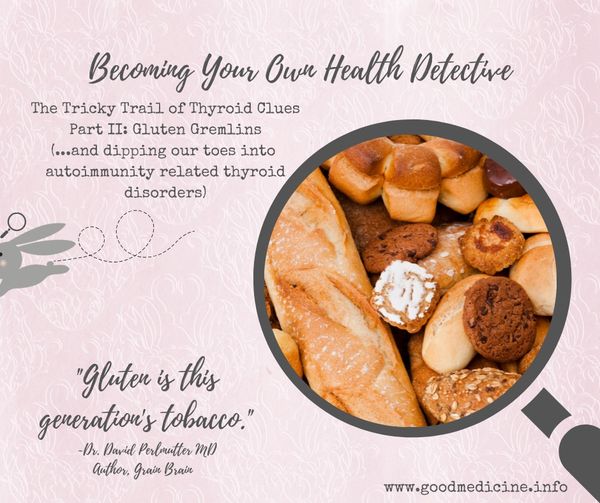
Here’s where we take a bunny trail detour to talk a bit about gluten. Unless you live in an untouched area of the wilderness with no internet, you’ll likely know that many people have issues with gluten. Generally, you hear about gluten and digestive disturbances such as celiac disease (another autoimmune disorder affecting the small intestine), but did you know that gluten is commonly a trigger for worsening both Hashimoto’s (hypothyroid) and Grave’s (hyperthroid) disease?
 detour to talk a bit about gluten. Unless you live in an untouched area of the wilderness with no internet, you’ll likely know that many people have issues with gluten. Generally, you hear about gluten and digestive disturbances such as celiac disease (another autoimmune disorder affecting the small intestine), but did you know that gluten is commonly a trigger for worsening both Hashimoto’s (hypothyroid) and Grave’s (hyperthroid) disease?
Gluten is a sneaky little son of a biscuit eater, for multiple reasons:
 It takes very little to cause great distress in gluten hypersensitive individuals…… like less than 1/20th of a teaspoonful according to some experts, and even less than that according to others.The after effects of a single gluten consumption/use can be felt for weeks to months after the occurrence in the gluten hypersensitive individual.Gluten flies under the radar and hides in the most seemingly innocuous of places: soy sauce, corn flakes, salad dressings, marinades, seasonings, processed deli meats, body and beauty care products, and candy (glucose syrup or dextrose can come from wheat) are just a few on the list.Some thyroid medications (and other medications and supplements too!) contain gluten as an inert filler ingredient. Currently the FDA does not have strict labeling requirements regarding the labeling of gluten positive medications. At the time of this writing, all brands of levothyroxine (except Mylan which is certified gluten free) contain gluten, as does the thyroid medication Cytomel. (And yes, I agree. Why in the world would the pharmaceutical industry use inflammatory gluten as a common filler, especially in a medication for a population prone to be gluten sensitive? As I’ve said before, we’re worth more as a commodity if we are sick than we are if we are healthy friends.
 )Other aliases of gluten include starch, pregelatinized starch, sodium starch glycolate, dextrin, dextrate, dextro-maltose, maltodextrin, sodium starch glycolate and more. Sneaky Pete, indeed!
Is all gluten bad? Resoundingly no. Although if someone is found to be gluten hypersensitive, it’s a good idea to avoid it as much as possible. Modern wheat and the ancient grain Einkorn are two very different grains containing different types and ratios of gluten. Not only is Einkorn considered to be vastly more nutritious than modern wheat, the troublesome type of gluten (the “D” genome) doesn’t appear to be present in Einkorn according to Dr. Davis, author of “Wheat Belly”. If you aren’t sure if Einkorn is a safe form of grain for you, try incorporating it into a food challenge. Einkorn is also much more highly digestible and because of its starchstructure, is less apt to cause blood sugar spikes.
 Resoundingly no. Although if someone is found to be gluten hypersensitive, it’s a good idea to avoid it as much as possible. Modern wheat and the ancient grain Einkorn are two very different grains containing different types and ratios of gluten. Not only is Einkorn considered to be vastly more nutritious than modern wheat, the troublesome type of gluten (the “D” genome) doesn’t appear to be present in Einkorn according to Dr. Davis, author of “Wheat Belly”. If you aren’t sure if Einkorn is a safe form of grain for you, try incorporating it into a food challenge. Einkorn is also much more highly digestible and because of its starchstructure, is less apt to cause blood sugar spikes.
For the non gluten hypersensitive individual there are a few more reasons to nosh on some tasty Young Living Einkorn spaghetti, pancakes, granola, or cereal…..Regular intake of gluten has been found to help mediate exposure to heavy metals. Conversely, those on a gluten free diet tend to have higher blood and urine levels of arsenic, lead, mercury, and cadmium ,commonly found in many well known lipstick brands,. If you already use YL Savvy Minerals lipstick, here’s a high five…. It’s toxin free!
 , here’s a high five…. It’s toxin free!
For being a simple little butterfly looking structure in our neck we often don’t think about, the thyroid is certainly complex and so easily affected by outside influence!
 looking structure in our neck we often don’t think about, the thyroid is certainly complex and so easily affected by outside influence!
xoxo~ liz