• Skip to primary navigation
  • Skip to main content
Book Your Health Coaching Call
Good Medicine

Good Medicine

Holistic Health Coaching

  • Home
  • Liz James
    • About Liz
    • Coaching
    • Book a 20 Minute Complimentary Coaching Call
  • Favorite Resources
    • BlessedByHisBlood
    • Young Living
    • Fast Like A Girl Certified Coach
    • Order supplements through my Fullscript store
    • Green Pasture (Coupon: Health10)
    • RogersHood Apothecary (Coupon: BEABLESSING for 10% off)
    • DolphinMPS
    • Company
    • Abundance
  • My Books
    • Becoming Your Own Health Detective Volume 1
    • Becoming Your Own Health Detective Volume 2
  • Blog
  • Cart

Health Clues

Health Clues in Your Fingernails #2

Liz James · January 5, 2021 ·

Our hands hold so many clues! If you missed part I (deciphering the lunula), you can find it here: https://goodmedicine.info/blog/health-clues-you-can-use-1://


​ ….. Now let’s move on to the whole fingernail. Today I’ll be covering a few more clues you can use to help “nail” down healthy habits and reverse possible deficiencies that ultimately will contribute to dis-ease.


What do healthy nails look like?
*When you are examining your nails, they need to be free from all fingernail polish. Because the nail bed is loaded with capillaries (tiny blood vessels) and fingernails grow relatively quickly, the ends of our fingers often can tip off on an early warning health concern. Nails are a snapshot of a person’s health over the previous 6 months…. So too, slow and steady wins the race when you are looking to repair or support what’s amiss.  


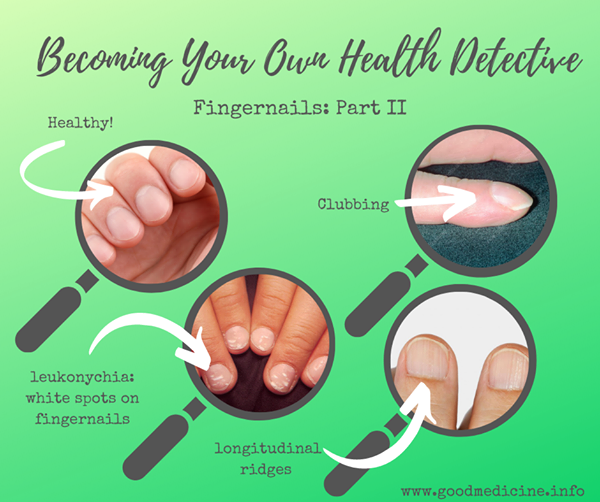
👍A healthy nail will have a transparent pink color and should be slightly shiny, smooth, and with a slightly (side to side) arched shape. Hardness of your nails comes from the presence of adequate sulfur needed for healthy keratin production (This is why we can thank YL’s Sulfurzyme… if you have been taking this supplement….. and have noticed stronger nails and hair).


*White Spots on nails: poor zinc load or excess refined sugar load
This is technically known as leukonychia and indicative of two things: a zinc “inadequacy” and/or an excess consumption of refined sugars. 
Zinc inadequacy is often common in people over the age of 60, but anyone can be susceptible! 


Other signs of a possible deficiency include thinning hair, acne, slow healing wounds,  worsening vision, worsening hearing or ringing in the ears, and an impaired immune system. Interestingly,  food doesn’t taste or smell much when you are zinc compromised (Does that sound familiar given the 2020 virus?… one of the key natural preventatives to the ‘rona is making sure you are getting adequate zinc in your diet!)


How do you know if your problem is excess sugar or a zinc deficiency? Do an honest assessment of your eating habits. Common foods high in zinc include: pumpkin seeds, grass fed beef, chickpeas, lentils, cocoa powder, cashews, yogurt or kefir, mushrooms, spinach, avocados, and chicken. If these are regular staples to your diet and refined sugar is kept to a minimum then I’ll bet your nails are free from white spots!  


What are some YL supplements that contain zinc? Hint: one of them is red! 
*Longitudinal Ridges: essential fatty acid deficiency
EFA’s are necessary for healthy skin, hair, heart, thyroid, prostate, brain, joints and nails! In addition essential fatty acid deficiency has been found to play a key role in inflammation, depression, and cognitive decline (including Alzheimer’s Disease).


Other signs of a possible EFA deficiency are dry scaly skin, a dry mouth, cracked fingertips or cracked heels (also a sign of a possible thyroid deficiency). 


Common foods high in EFA’s include flaxseed, chia seeds, walnuts, pumpkin seeds, “fatty fish” and fish oil, and brussel sprouts.


Which Young Living supplements might longitudinal ridges be telling you your body is craving if you don’t tend to each the above foods regularly? I can think of two: OmegaGize3 and MindWise.


*Clubbing: low oxygen in the blood
Clubbed fingernails curve downward at the tip of the finger. It is associated with conditions including lung, liver, or heart disease and both celiac and inflammatory bowel disease all of which, in their own way, affect oxygenation of blood. Clubbed fingers can be “tested” at home by using a simple visual test called “Schamroth’s Sign” (details easily found with a quick internet search).   Clubbing is also a possible clue for anemia. These all have the potential to be fairly serious in nature, and I would suggest reaching out to your favorite health professional if your fingernails (AND) other clues are tipping you off to something amiss that has not yet been “officially” diagnosed.  I have seen many many clubbed fingernails in my pharmacist days and it’s a clue worth taking note of.


A healthy YL drinkable supplement that supports oxygenation of the blood immediately comes to mind.  I’ve yet to meet anyone who wouldn’t benefit from daily NingXia Red! 
The rest of the fingernail clues will have to wait until Part III! 
xoxo~ liz
(message me if you have no idea what Sulfurzyme, NingXia Red, OmegaGize3 or MindWise is, and would like to learn more!)  


#caringissharing
#applicationofknowledgeispower
#keepaneyeonyourfingernails
#goodmedicine
#goodmedicineisknowingthyselfwell
#ThanksYL
Finding Answers to your own Health Problems

Liz James · December 28, 2020 ·

Last week, I wrote about all the fascinating information you may learn from looking at the clues embedded (literally) in the nether regions of fingernails. You can find that post here if you need to catch up: https://goodmedicine.info/blog/health-clues-you-can-use-1

​A clue means next to nothing if it is singular….. You’ll  need at least a few clues if you are to be sure you are headed down the right path. 


Since we are only in the embryonic stages of becoming your own health detective, here are a few quick self assessment tools every good health detective needs:
*Honesty: If you are to be your own health detective, it’s important to acknowledge lifestyle choices and known consequences. The “it won’t happen to me” mindset will never work….nor will the hypochondriac’s lament. If you are going to do the detective work, be honest with yourself……using your clues to improve your wellness quotient thru diet, lifestyle changes and using supplements (and/or YL essential oils) when you suspect support is needed will go a long way to turning back the physiological clock.


*Labwork: Every adult should have bloodwork  done annually (more often if there is a visible problem). Even the uninsured or “undoctored” can get bloodwork done without seeing a doctor (message me if you’d like help doing this). I’ll cover what I consider “essential” labwork in a future post, so at the very least you’ll know what labs to request your doctor run for you.


*One clue does not make a dis-ease or a diagnosis. #clustercluesforthewin


*How do you feel? Think this over. Do you feel great most days? If your answer hovers more around the “meh” answer, here’s where you’ll want to start. There are many many posts within this group that addresses supportive measures for most of these topics:
👉Do you get enough sleep?
👉Do you exercise vigorously and regularly?
👉Do you know your recent blood pressure and blood sugar numbers?
👉Do you have a “healthy” bowel movement daily?
👉Do you eat in a healthy manner? 
👉Do you have a close set of friends, participate in life fully, attend church?
👉Do you laugh often and enjoy life?
👉Do you avoid vices? (smoking and regular alcohol consumption especially)


*Consider keeping a health journal. Write down your clues as you find them. This will be very helpful to you as you learn how to be a better CEO of Y.O.U Incorporated in 2021, and will also help you decide which supplements or oils might need to be on your monthly “must haves” for 2021.


 *Know your limits. If you have found several clues pointing to a significant health issue, please contact your preferred health professional. Naturopaths, Integrative medicine doctors, and functional medicine doctors are my personal first choice as they tend to look beyond the symptoms and address the root cause.


Last week I read several comments when discussing less than prominent lunula….. Fewer than 8 prominent lunula may be an indication of low cellular oxygen, poor circulation, a chronically weakened immune system, a possible thyroid disorder, or a Vitamin B12 Deficiency. Lots of possibilities, right? If you didn’t know where to start (since this is a first clue), what daily Young Living supplement may be supportive of most of these conditions? (Hint: It’s red ).
xoxo~liz

#sharingiscaring
#applicationofknowledgeispower
#goodmedicine
#ThanksYL
#NingXiaRedChallenge2021
#becomingyourownhealthdetective

Health Clues in Your Fingernails #1

Liz James · December 22, 2020 ·

Learning to “read” your own body is a skill that everyone learned to some degree in days gone by….. much like tracking an animal🐾, interpreting weather signs , or “reading” 🌱 plants in a forest. Failure to do any of these things well could have cost you your life. Now we tend to rely on professionals (or electronics) to work exclusively on our behalf. There are many problems to simply handing over life skills to someone else to manage, not the least of which is personal vulnerability….. I mean, who has a paper map in their car?… and what would happen if your GPS suddenly shut down?


When we wait for someone else to “find” the problem, a slippery slope may result. Just like having low air in a tire, it’s so much easier to air the tire back up and identify and fix the cause of the low tire pressure,  than it is to drive on it until it’s flat and damaged and has to be completely replaced (expensive!!) by a professional. 


Throughout 2021, I’ll be unpacking “health clues you can use” to help you decide which supplements and essential oils may warrant further investigation or perhaps which lifestyle changes your body may benefit from. #wearealluniquelymade

Today, let’s unpack the lunula… finger by finger! 
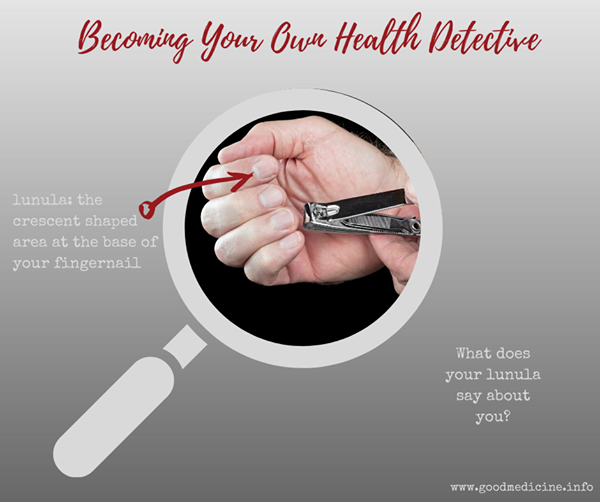
The entire body is a storehouse of clues….. Especially hands and nails! Fingernails are a snapshot of the last 6 months of a person’s health….. The lunula is the crescent shaped area at the base of your fingernails… and that’s the only part of the fingernail I’m talking about today. Ideally, you want  8 of your 10 fingernails to have prominent lunula. Fewer than 8 prominent lunulas on the fingernails may be an indication of low cellular oxygen or poor circulation overall.


Lunula size also differs among different ethnic groups, and they are commonly absent on children. Keeping an eye on “normal” within your individual body is what’s important. Changes in size of the lunula are ultimately what should raise a hairy eyebrow. Overall, if the lunulas grow in size to cover more than ⅓ of the nail bed, if may indicate an ongoing endocrine disorder or cardiovascular issue. If the lunulas have almost disappeared , it may indicate low blood pressure, a weakened immune system, thyroid gland disorder or a vitamin (B12) deficiency.


The overall color of the lunulas are important too (taking into consideration…. Did you squish it with a hammer recently?!?😣)


Gray: severe fatigue, digestion disorders, and possible nutrient deficiencies
White: healthy and natural. Should be several shades lighter than skin tone.
Purple: poor circulation and lack of oxygen.
Pink: may indicate lower levels of physical activity and lung function
Black: a common symptom of heavy metal poisoning
Half pink/ Half white accompanied by a thinner darker band of color: possible kidney dis-ease. 


Moving on to each finger……
Pinky Finger: the lunula should be nearly invisible. Its appearance may be an indication of the function of small intestines, kidneys, and heart.
Ring Finger: the lunula should be prominent, and may be related to the health of the reproductive and lymphatic systems, and to a lesser extent, the digestive system.
Middle Finger: should also be prominent, and may be related to the health of your brain and vascular system. If your lunula is absent on this finger, it may indicate a potential issue with blood vessels or higher blood pressure.
Index Finger: should also be prominent. If it is tiny or nearly gone, it may indicate issues with your intestine or pancreas (get your glucose checked! Home meters are very inexpensive and do not require a prescription). A tiny or absent lunula on this finger may also indicate a chronic (not acute) upper respiratory dis-ease.
Thumb: should also be prominent, but not more than 25% of your nail bed. It may be an indication of the workings of the lung and spleen.


Matthew 24:28 contains an interesting proverb. “For wherever the carcass is, there will be vultures gathered.” There is a wise lesson here. Seeing one clue does not mean much….. until you put them together with many clues (the difference between one vulture flying over head vs several circling). Clue gathering is a talent, but it’s one we can ALL cultivate…. After all, our ancestors did it with little to no formal education!
Let’s have some fun………knowing what your lunulas just “told” you, how did what they say align with what you already know about your body? AND, which  YL essential oils or supplements is your body asking for based upon these clues?
xoxo~ liz

If you’d like more information in an individualized coaching format, 2021 is the year to do it!


#caringissharing
#applicationofknowledgeispower
#goodmedicine
#goodmedicineisknowingthyselfwell
#ThanksYL
PS: Do not interpret this post as medical advice…. My intention is not to diagnose, treat, or cure anyone…. only to raise awareness that you are the lone CEO of your body, and you can easily gather the tools to build a healthier life! Consider making 2021 your year to learn to read the roadmap that is your body!

Body odor

Liz James · August 5, 2020 ·

OK, this may sound really weird……. But have you ever thought much about body odor?…. And how some people have some seriously bad B.O. while other people don’t even give off offensive B.O. when they sweat, even if it’s during a hard workout? Why is this?


It’s not because of hygiene on the outside…. it’s because of hygiene on the INSIDE. Buildup of oxidized fats, malformed proteins, and other chemical “trash” in the body generates an aroma that no soap (or toothpaste or mouthwash) can overcome. (Some diseases can do this too, but for the sake of this convo, I’m only focusing on cellular hygiene today.)


What causes poor cell hygiene within us?…. All these rancid fats and denatured proteins that the body simply can’t get rid of fast enough?  I’m sure you’ve heard of free radicals and how bad they are for a body. Actually, they’ve been given a bit of a bad rap. They are absolutely essential to a healthy happy body, but when too many free radicals start gathering in the body, something called oxidative stress begins occurring.


Q: How do I slow down the production of free radicals and avoid oxidative stress?
A:  Clean up your “personal space”.
👉Limit your consumption of fats and oils that have been exposed to light, air and heat (which turns them rancid). Fried fast foods are notorious culprits.
👉Avoid preservative laced foods and processed meats
Stop contributing to “indoor smog” in your own home. #useyourdiffuser  Avoid damaging and toxic chemical household cleaners & artificial air freshening agents.
👉Avoid Smoking and being around second hand smoke
Make sure the water you drink is free from chemicals (most tap water is not)
👉Understand that many medications contribute to the formation of free radicals. Do your due diligence and look for healthy alternatives (or ways to improve your health so that you won’t need medication) whenever possible.
👉DO seek out strong antioxidants and incorporate them into your diet. Some of the strongest ones are wolfberries (also known as goji berry), blueberries, plums, cherries, aronia (also known as chokeberries), and pomegranates.
Not surprisingly, all of these are ingredients in our YL NingXia Red. 


Q: What does Oxidative Stress do in our body?
A: It accelerates the aging process, contributes to cancer, atherosclerosis, Alzheimer’s, Parkinsons, and other diseases.
Although there are no officially recognized “symptoms” of oxidative stress, fatigue, headaches, noise sensitivity, memory loss, brain fog, muscle and joint pain, wrinkles, gray hair, vision trouble, decreased immunity AND strong BODY ODOR are all signs pointing towards damaging oxidative stress in our bodies.
So, if you are participating in our team NingXia Red Challenge this month (August), you might notice a change in your body odor for the better my friends……. And THAT is a very very good thing!
xoxo~ liz

#alltheNingXiaRed
#NingXiaRedChallenge
#totalbodyhealth

Itovi

Liz James · April 24, 2020 ·

​I’m curious about a few things……. 
1.Have you ever had an Itovi scan? If so, how often do you get them?
2.Do you understand the information that the Itovi scan relays?
3. Do you own an Itovi scanner? And if so, where do you live?
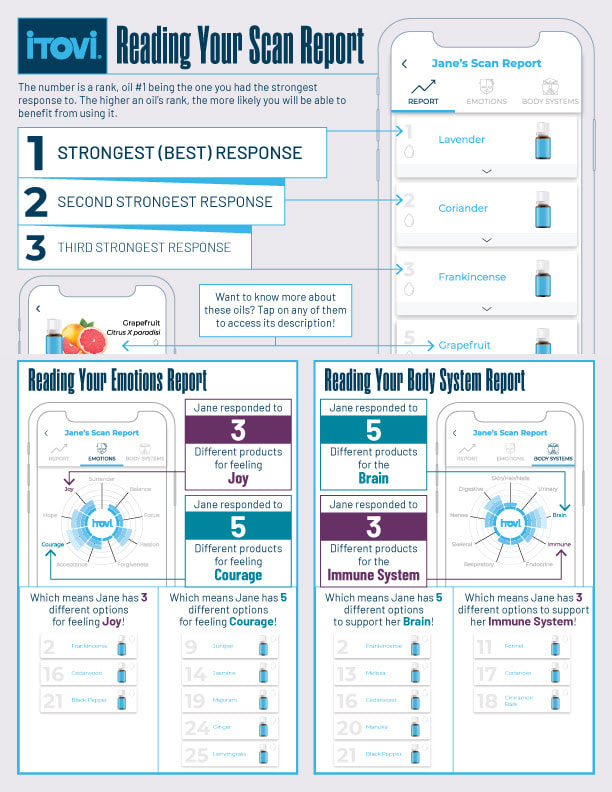
Itovi updated their app awhile back, and the graphic attached is an easy to read explanation of what the new scanned info looks like . I realized when I was looking at it that I was misinterpreting the scan results slightly. I hope it helps someone else too! 

For more information about the Itovi:

itovi.com

#youneedanItoviscan
#letshookyaup
#bettertogether
#Useyourtoolsknowyourtools

  • « Go to Previous Page
  • Page 1
  • Interim pages omitted …
  • Page 16
  • Page 17
  • Page 18
  • Page 19
  • Go to Next Page »

Book Your Health Coaching CallBook Now

Elizabeth James

469.425.9091

ebj0203@gmail.com